














































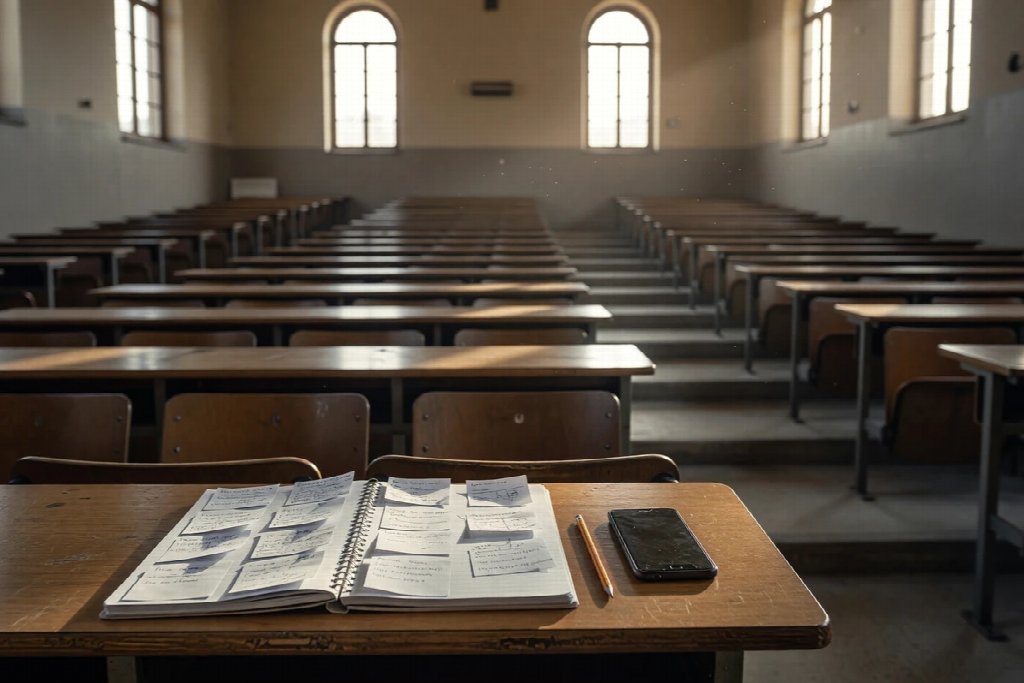
The recording is made in this room; the studying that counts happens afterwards, on cards like these
You can turn lecture recordings into study notes in about twenty minutes, and the evidence says most people spend those twenty minutes on the wrong thing. Transcribing is the cheap part. Reading the transcript afterwards does close to nothing, and the automatic summary most tools generate does not do much more. What a transcript is genuinely good for is making the two techniques that do work almost free to build.
This is written for anybody sitting through recorded lectures this semester, and for the people teaching them. The two papers quoted below are a 2013 review in Psychological Science in the Public Interest and a 2019 replication in Educational Psychology Review, both checked on 4 September 2026.
The short version
- Only two of ten studied learning techniques were rated high utility: practice testing and distributed practice.
- Rereading and summarisation were both rated low utility, which covers most of what people do with a lecture transcript.
- The claim that handwritten notes beat typed ones did not replicate, so the capture method is not the interesting variable.
- The transcript is raw material. The learning happens when you turn it into questions and then space them out.
What does it take to turn lecture recordings into study notes that work?
Two techniques, both named in the literature, and neither of them involves reading.
In 2013, Dunlosky, Rawson, Marsh, Nathan and Willingham reviewed ten common study techniques for Psychological Science in the Public Interest and rated each one for utility across different learners, materials and test formats. Two came out on top.
| Utility rating | Techniques |
|---|---|
| High | Practice testing, distributed practice |
| Moderate | Elaborative interrogation, self-explanation, interleaved practice |
| Low | Summarisation, highlighting, the keyword mnemonic, imagery use for text learning, rereading |
Now read that bottom row against what people actually do with a lecture recording. Reading through the transcript before an exam is rereading. Having a tool generate a tidy summary of the lecture and revising from that is summarisation. Both sit in the low utility band, and they are the two outputs that every transcription product advertises.
This is not an argument against transcribing lectures. It is an argument against believing the transcript is the finished product. The review is careful about why the low-utility techniques stay popular: they feel productive, they are easy to do while tired, and they produce an artefact you can look at. None of that is the same as remembering the material in three weeks.
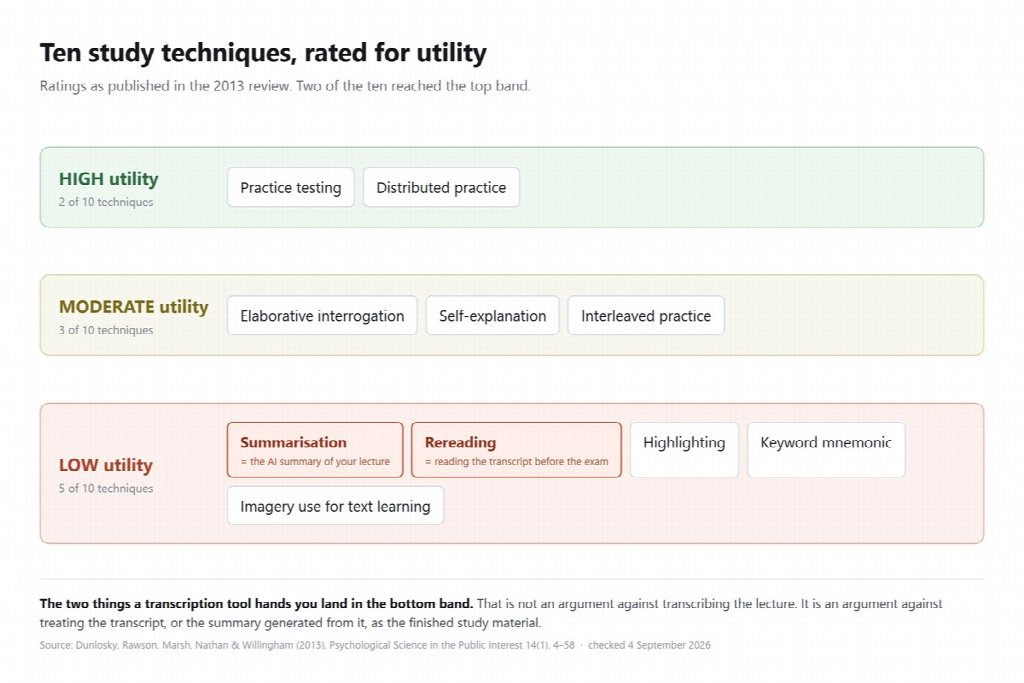 Two techniques reached the top band; the two outputs a transcription tool hands you sit in the bottom one
The handwriting objection, and why it stopped working
The usual objection to recording a lecture is that writing notes by hand is what makes them stick. That finding did not replicate.
The original result came from Mueller and Oppenheimer in 2014, under the title The Pen Is Mightier Than the Keyboard. In 2019, Morehead, Dunlosky and Rawson ran a direct replication in Educational Psychology Review and extended it, adding a group using eWriters and, more importantly, a group that took no notes at all.
Performance did not differ consistently between any of the groups, including the group that wrote nothing down. Once students had studied their notes, the differences shrank further. A meta-analysis combining the direct replications found small effects favouring longhand that were not statistically significant. The authors’ own conclusion is that “concluding which method is superior for improving the functions of note-taking seems premature”.
The useful reading of that is not that note-taking is pointless. It is that the capture method is not the part that decides the outcome. Arguing about pen versus keyboard versus recorder is arguing about the cheapest step in the process. What happens to the notes afterwards is doing almost all of the work, and that is the part nobody optimises.
There is a second reason the finding mattered less than it seemed to. The original study measured performance on tests taken shortly after a single lecture, which is not the situation any student is actually in. Real courses run a full semester and end with an exam covering all of it. Over that timescale, the question of what your notes looked like on the day matters far less than whether you ever went back to them, and the review in the previous section is unambiguous about which kind of going back pays.
Get a transcript worth working from
Three things decide whether a lecture transcript is usable: where you sit, what you record, and what structure survives the conversion.
Sit near the front, or near whichever speaker system carries the lecturer’s voice. Lecture halls are the worst case for automatic transcription: a distant speaker, hard reflective surfaces, and audience questions asked without a microphone by someone forty rows away. A phone on the desk in row two produces a transcript you can fix in ten minutes. The same phone in row twenty produces one you will abandon.
Record one clean source rather than mixing several. If the course already posts a lecture capture file to the learning management system, start from that instead of your own recording, because it is usually taken from the room’s own microphone feed.
Then convert it. An audio file to text converter takes the recording you uploaded or one you captured in the browser, and returns punctuated text with speaker labels and timestamped chapters, exportable as TXT, DOCX, PDF or Markdown. It works from a file rather than a link, so the recording on your phone or the file your department published both go in the same way.
Keep two things from that output. Timestamps, so that when a sentence makes no sense you can go back and hear it rather than guessing. And the chapter breaks, because those are the boundaries you will use to cut the material into questions.
Fix the vocabulary before you do anything else. Automatic transcription is reliable on ordinary English and unreliable on exactly the words a science lecture is made of: reagent names, unit abbreviations, an author’s surname, anything Greek. Those are also the words your exam will ask about, so ten minutes correcting them is the highest value ten minutes in this whole process. Leave the filler words and the comma splices alone. Nobody is going to read this document.
Worth being explicit: none of this step produces learning. It produces raw material. The learning is in the next section.
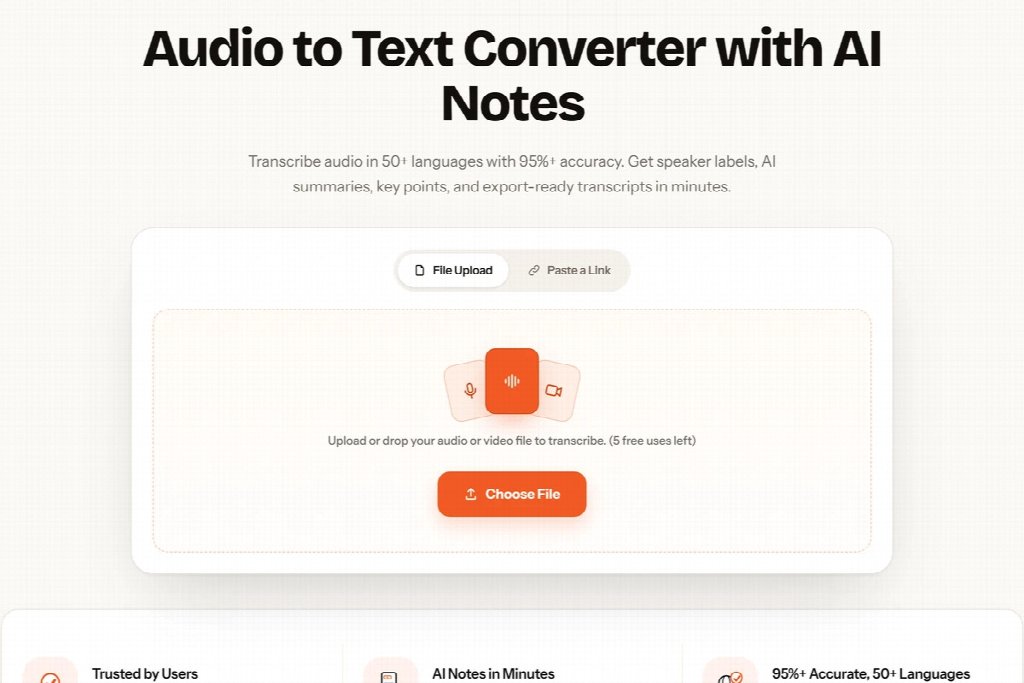
The converter takes an uploaded lecture recording and returns punctuated text with speaker labels and timestamped chapters
Turn the transcript into retrieval practice
Rewrite the transcript as questions. This is practice testing, the technique that shared the top utility rating, and it is the only step here that actually produces learning.
Four passes, each one fast:
- Every definition becomes a gap. Find each sentence where the lecturer defines a term and delete the term. “The enthalpy change when one mole of a substance forms from its elements in their standard states is called the standard enthalpy of _______.”
- Every chapter heading becomes a question. Your transcript already has chapter breaks. A heading that reads “Le Chatelier’s principle” becomes “What happens to an equilibrium when you increase the pressure, and why?”
- Every because becomes an explanation prompt. Search the transcript for “because”, “which means” and “so”. Those sentences are the causal claims that exams ask about. Turn each into a prompt that starts with “Explain why”.
- Keep the answers somewhere else. A question with the answer visible underneath it is rereading again. Put answers on the back of the card, in a second column you cover, or in a separate file.
Here is the whole loop on one line of a chemistry lecture. The transcript says: “So the reaction is exothermic, which means raising the temperature shifts the equilibrium back towards the reactants.” That single sentence gives you a gap-fill on the definition of exothermic, a question asking which way the equilibrium shifts and why, and an explanation prompt asking what happens instead if the reaction is endothermic. Three retrieval attempts out of one sentence you did not have to write.
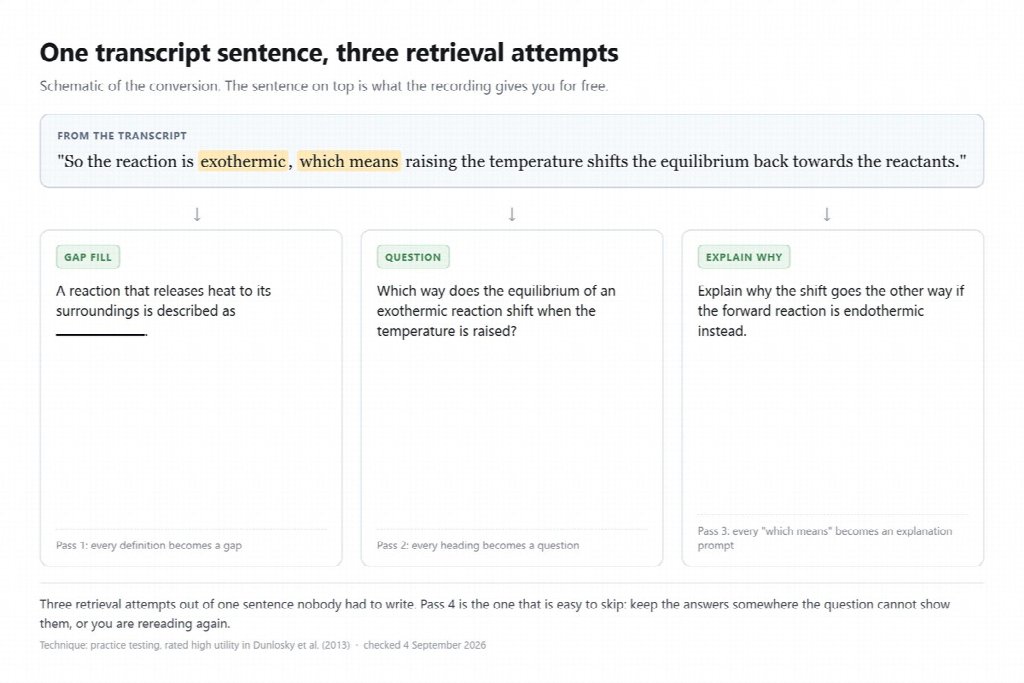
One sentence from the transcript produces three retrieval attempts, and none of them required writing the sentence
Schedule the reviews instead of cramming
Distributed practice was the other technique rated high utility, and putting it into practice needs a table rather than a technique.
Spread the retrieval attempts out instead of doing them all the night before. Spacing beats massing consistently across the studies in the review. It does not support any particular number of days as universally optimal, because the best gap depends on how long you need to retain the material, so treat the schedule below as a starting shape rather than a formula.
| When | What you do | Roughly how long |
|---|---|---|
| Same day as the lecture | Convert the transcript into questions | 20 to 30 minutes |
| Two days later | First retrieval pass, all cards | 10 minutes |
| One week later | Second pass, only the ones you got wrong | 10 minutes |
| Three weeks later | Third pass, all cards again | 15 minutes |
| Exam week | Final pass, plus the cards you have failed twice | 20 minutes |
The total is around an hour and a half per lecture, spread across a month. A single cramming session before the exam usually costs more than that and leaves less behind.
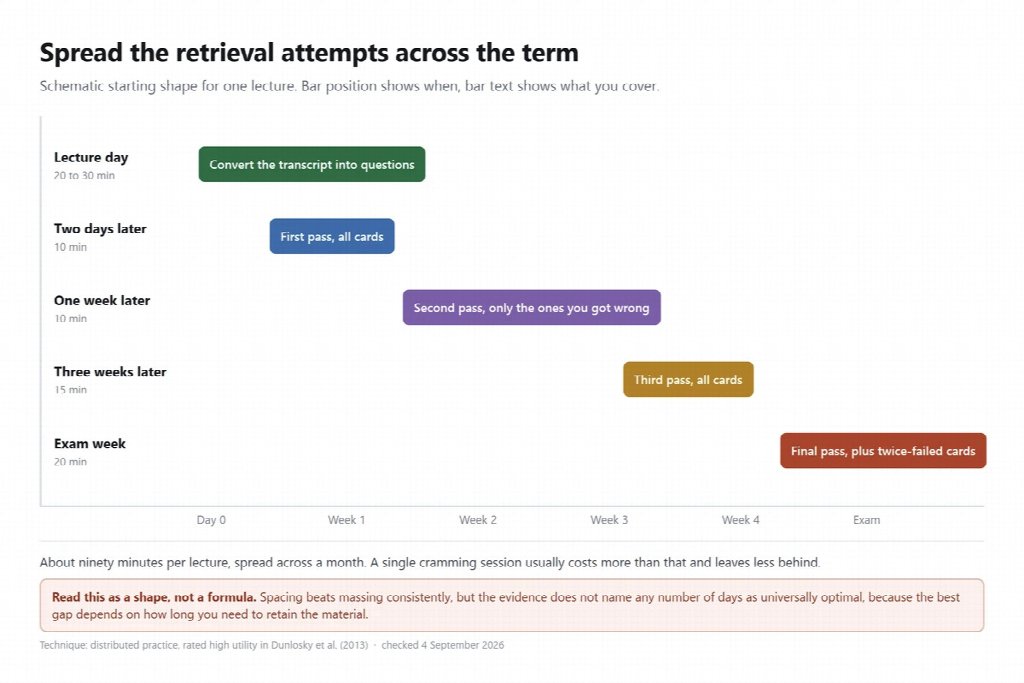
About ninety minutes per lecture spread across a month, with the caveat that no gap length is universally optimal
Frequently asked questions
Is it allowed to record a lecture?
Two places govern it, and neither of them is a general rule you can look up once. The first is the course syllabus, because instructors set recording permission course by course and most universities ask them to state it there. The second is your accessibility or disability services office, which runs a separate and usually easier route for recording as an approved accommodation. Many institutions permit personal recording for study while prohibiting sharing or reposting it, so read the syllabus rather than assuming, and ask the instructor if it says nothing.
Should I still take notes if I am recording?
Yes, but shorter ones. The replication evidence suggests the format of the notes is not what matters, so use the live session for the thing a recording cannot do: writing down what you did not understand. That list is what tells you which parts of the transcript to convert into questions first.
How accurate does the transcript need to be?
Accurate enough that the technical terms are right, which is where automatic transcription fails most often. Fix the vocabulary and the names, then stop. Filler words and imperfect punctuation cost you nothing, because you are not going to read the transcript. You are going to mine it.
Does this work for maths and problem-based subjects?
Partly. Retrieval practice and spacing apply to any material, but a transcript of a worked derivation is a poor source for questions, because the value is in the steps on the board rather than the words. For those lectures, use the transcript for the parts the lecturer only said out loud, which is usually the reasoning for why one method was chosen over another, and get your practice questions from the problem sets instead.