






















































































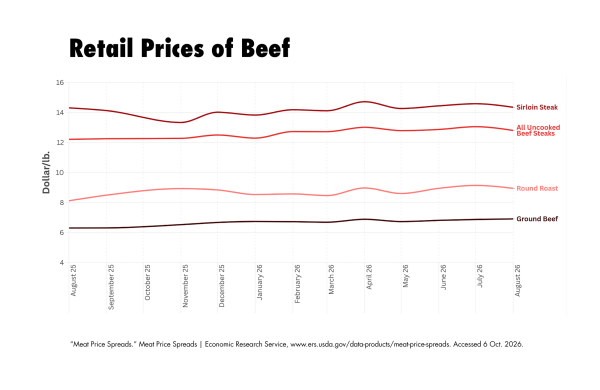
According to the U.S. Department of Agriculture, beef prices are at an all-time high, with overall cattle size at a historic low of 75 years, and prices are predicted to rise an additional 10% for the full year. In a time of rising inflation and no relief in the grocery store, consumers may wonder which factors of the current economic climate are causing their high-priced beef.
Brian Coffey and Glynn Tonsor, professors in the Department of Agricultural Economics, have conducted research to provide answers on where the price increase came from.
The two K-State agricultural economists’ work has served to make something clear: consumer demand for beef has played a bigger role in price increases than people realize. Tonsor and Coffey co-authored an assessment of the U.S. beef market. According to the assessment, although it is true that the low herd size contributes to prices, their data revealed that market changes have been “anything but one-dimensional” and are decades in the making.
Tonsor and Coffey said consumers can look at the situation from a supply-demand position.
“There are developments on both supply and demand that have led to higher prices,” Tonsor said. “The most important economic force is the strong beef demand. Anytime you have a product, in this case, beef, that the public wants more than in the past … and nothing else has changed, we expect the price to go up.”
The first thing Tonsor said he wants consumers to keep in mind is that strong consumer demand will increase prices, and that this year’s price increase has more to do with high demand than anything else.
“The average American consumed more beef in 2025 than in 2024,” Tonsor said. “They paid more for it, even beyond inflation. The price went up more than the rate of inflation in 2025 even though the volume in that market went up. That only happens if the public values those pounds more because of demand growth.”
Despite herd size being at an all-time low in the U.S. this year, Coffey said a shrinking herd size is a normal part of the “cattle cycle” and should not alarm consumers.
“This is a normal thing,” Coffey said. “In times where farmers think that keeping beef cows will be profitable, they grow their herds. … Then, when economic times shift, or there’s a drought or political uncertainty, a lot of those same farmers will shrink their herds because it makes more sense to get rid of cows and have less of an investment tied up in them. … Then eventually it hits kind of a low, things shift and it grows again … it is up and down over time.”
Overall, Coffey and Tonsor’s research found that consumers can look to an increase in demand, rather than various external factors, when noticing high prices.
“We did some basic calculations that say between 2024 and 2025 that about 83% of that price increase was due to consumer demand, and 17% of the price increase was on the supply side,” Coffey said. “It’s not necessarily as big of a problem as it seems; it is mainly due to consumer demand. … That doesn’t diminish the fact that livestock producers right now are battling some really tough challenges with elevated input costs. … There are some difficult times right now even at the grocery store with people trying to afford their grocery bills.”
AgManager.info, an extension site for agricultural economy information, contains Coffey and Tonsor’s research reports. Tonsor said his ‘Meat Demand Monitor’ program provides monthly updated reports of survey data.
“[The program] is based here at K-State … and it’s a massive survey of U.S. residents,” Tonsor said. “We’re surveying over 3,000 U.S. residents every month; we’ve been doing it for seven years now. … We track what’s important in your purchasing. It’s like we’re figuring out what is important to your buy and don’t buy decision when it comes to meat, protein and taste.”
According to Tonsor’s research, customers prioritize taste and eating experience when purchasing beef.
“It outranks price,” Tonsor said. “Price matters; I’m an economist, I can’t ignore price, but taste is more important than price. The reason, in my opinion, why beef demand is as strong as it is, is the public thinks it’s tasty. Because that’s the most important determinant on their buying decision, it favors a higher price because it’s consistent with a market trying to allocate those pounds to the people that value them more than they did five years ago.”
Both Coffey and Tonsor said they advise against regulations being made now to remedy the low herd size because it would cause long-term consequences in the beef industry.
“Let markets work,” Tonsor said. “Most market interventions, whether it’s federal, state or otherwise, whether it’s a new policy, a regulation, subsidy, whatever those interventions are, almost always … have an unintended consequence in the long term. If I do something today to speed up herd expansion, I’m going to actually shrink beef supply next year. … I would have to keep young females [cows] out of the production system and in the breeding system to facilitate a bigger herd. A natural consequence of that is … we have less domestic beef production. I’m not saying that’s right or wrong, but it’s very clearly a consequence of that policy intervention that artificially changed the herd expansion.”
Coffey said there is not as much of an urgent need to grow herds back to the size they used to be due to modern beef cattle farming being more efficient at growing larger cows.
“We will grow the herd back once economic conditions are such that producers are willing to make those investments,” Coffey said. “There’s just a lot of uncertainty right now. … We probably won’t grow it back to as big as it was in, say, 2019, just because we don’t need as many animals now. I would look at it more as an example of markets working in a complex supply chain, moving beef from the cow calf stage … all the way to putting beef in the meat case at the grocery store. That process takes a couple of years, and so it’s a very complex chain of events that happens to make all the beef get to where we want it to be. It just takes time for markets to work.”