



























































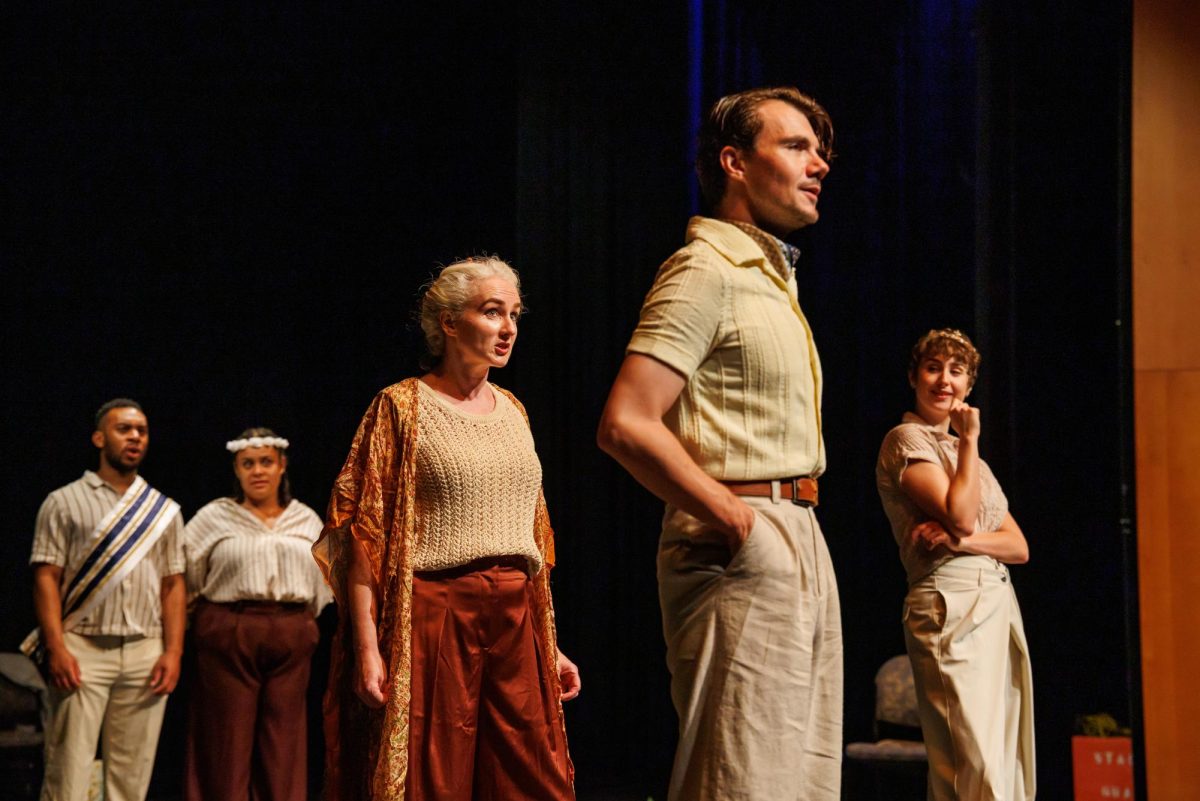











































Actors From The London Stage performed “Much Ado About Nothing” at McCain Auditorium on Oct. 9. The troupe’s work went beyond the stage, however, offering students opportunities to engage with Shakespeare in new ways through workshops and hands-on learning.
Founded over 50 years ago as a collaboration between University of Southern California professors and the Royal Shakespeare Company, Actors From The London Stage formed to educate college students and give them a more hands-on approach to studying Shakespeare.
The troupe’s structure is part of what makes it so unique. According to troupe member and actor Grace Lilley, there are four core components: a cast of only five actors, all actors play multiple roles, no director and everything seen in the show must fit in a 50-pound suitcase.
That collaborative process allows each actor to contribute to the production while sharing responsibility for the final performance.
“The fact that I can point at the play, say 20% of that is mine and also, I get to share the other 80% with such wonderful people,” Lilley said. “I love the camaraderie.”
Each cast member also has a responsibility while touring, including managing social media, travel and tech. Lilley’s role is education lead, where she is in charge of leading classes and workshops for students.
As education lead, Lilley also works with professors to develop workshops tailored to their classes and learning objectives. The workshops vary depending on the subject and students’ needs, ranging from exploring Shakespeare’s language and performing scenes to using acting exercises to build confidence and encourage students to interact with one another.
“Just like a different approach than sitting behind a laptop, listening to a lecturer, keeping it more active, keeping it more … I don’t know, a bit more unusual,” Lilley said. “And kind of pushing those boundaries of like, this might not be something that you do every day, but hopefully it’s something that you find helpful or at the very least you find fun.”
For Lilley, the workshops are about more than teaching students how to perform Shakespeare. She said the activities also challenge the perceptions that his work is difficult to understand or intended only for certain audiences.
“It’s also to kind of demystify the idea of Shakespeare being for the elites,” Lilley said. “The idea that it’s something that doesn’t belong to everybody. The idea that it is something that’s so far removed from the way that we speak now, or the way that we communicate now.”
Lilley said Shakespeare’s stories remain relevant because they explore experiences audiences continue to recognize, even centuries after the plays were written.
“Shakespeare’s silly, Shakespeare’s goofy, Shakespeare’s riddled with dick jokes, Shakespeare writes plays about how excruciating it is to have a crush on somebody,” Lilley said. “Shakespeare writes silly stuff, and it’s not something that doesn’t belong to you.”
That is the main message she wants students to take away from the troupe’s visits.
“Shakespeare’s cool,” Lilley said. “Shakespeare’s for everyone.”
For Lilley, making Shakespeare accessible is about more than understanding the playwright’s words. It is about connecting with stories and experiences beyond one’s own.
“Plays are one of the oldest ways of communication that we have, and it’s just storytelling,” Lilley said. “Every time you go and see a play, it’s almost like a workout for your empathy.”
Whether onstage or in the classroom, Lilley hopes to make Shakespeare less intimidating and remind students that his stories are meant for everyone to enjoy and connect with.