

























































In the spring of 1974, Justice Dan Biles was not thinking about appellate opinions or judicial consensus.
Instead, he was thinking about concerts.
As the arts and entertainment editor for The Kansas State Collegian, Biles got promotional records mailed to him from record companies and talked his way into shows. He brought his own camera. He burned printing plates. He did a little bit of everything.
“It was a lot of fun,” Biles said.
At the time, journalism was the plan. Law was not.
“I went to law school intending to be a better journalist,” Biles said.
After graduating from Kansas State with a journalism degree, Biles worked as an Associated Press reporter in Topeka. While covering the Statehouse, he enrolled at Washburn University School of Law. His schedule was packed with law classes in the morning, and reporting in the afternoon and evening.
However, he did not go to law school to become a judge, but because journalism felt uncertain.
Biles worried that without additional education, he was “vulnerable” in the industry. He believed a law degree would add stability and sharpen his reporting. Instead, it slowly redirected his career.
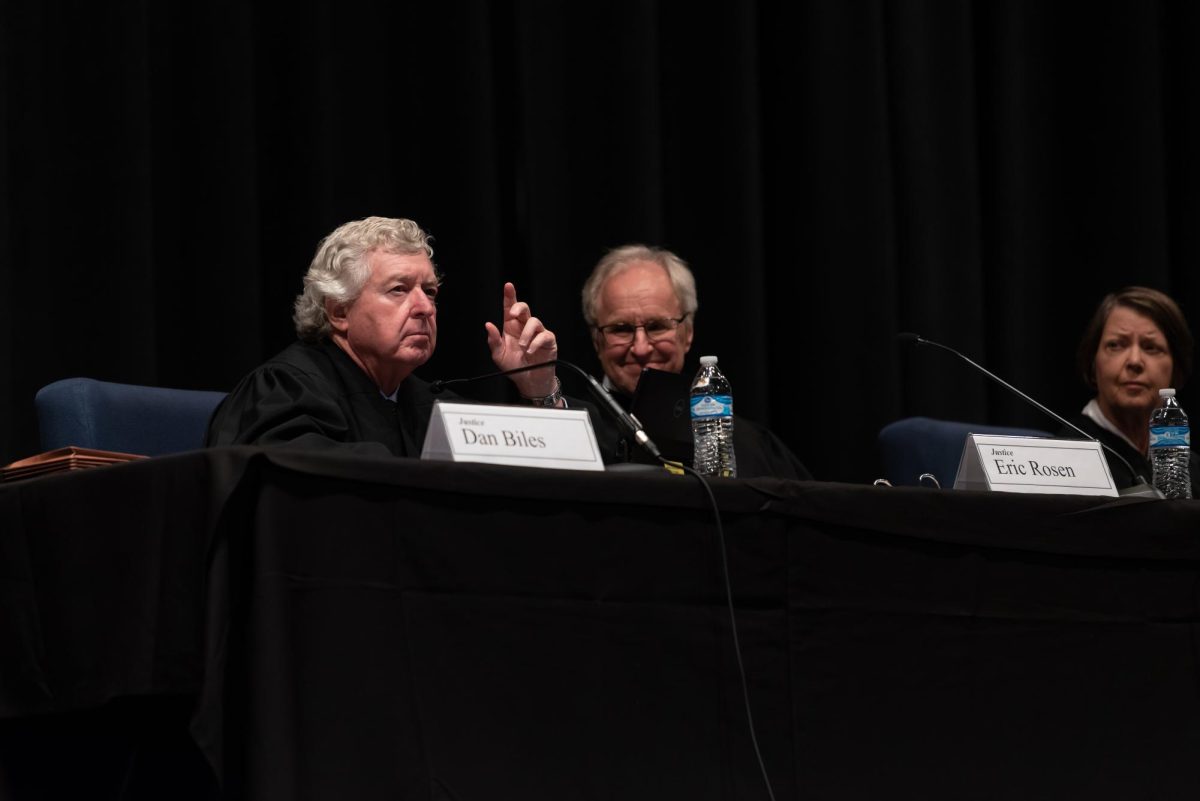
Biles went on to serve as an assistant attorney general, attorney for the Kansas State Board of Education and general counsel for the Kansas Turnpike Authority. He spent 24 years in private practice before being appointed to the Kansas Supreme Court in March 2009.
Even after decades of long hours in private practice, he said the court has been the most demanding role of his career.
“When I got this job with the court, I never worked harder,” Biles said.
The work requires precision, patience and consensus. It also comes with a kind of isolation.
“I suspect people don’t know how isolating it is to be an appellate judge,” Biles said. “I have kind of a cloistered life as a judge.”
That isolation is part of what makes his return to campus each week meaningful.
Since 2019, Biles has taught media law and ethics at K-State. He did not seek out the role, but was instead asked to step in when the previous instructor retired. More than six years later, he is still teaching.
“It’s one of the few opportunities I have to get out and be with people,” Biles said. “It’s what lets me have interactions with students.”
For Biles, teaching is not separate from his judicial work; it strengthens it.
“It makes me a better lawyer,” he said. “It forces me to connect the dots.”
In his classroom, he breaks down First Amendment principles and media law cases into their most basic components. He urges students to slow down, to think carefully and to pay attention to the smallest details.
“Read to the period,” he tells them.
The advice applies as much to Supreme Court opinions as it does to student news stories.
More than 50 years after sitting in The Collegian newsroom, Biles still finds himself back in a classroom talking about media, expression and the power of words. The setting has changed. The title has changed. But the through line has not.
Whether reporting at the Statehouse or writing opinions that shape Kansas law, the work comes down to connecting the dots and paying attention to the details.
All the way to the period.