








































































































Whether you are writing a novel between classes or preparing a story for a workshop, revising the same scene several times can make it harder to see what is actually on the page. You know the conversation and expect the next sentence. That familiarity is useful while writing, but it can hide small repetitions and awkward turns of phrase. Hearing the draft through text to speech gives those same words a different way to reach you.
The voice does not know the sentence you intended to write. It works from the text you supplied. Sometimes that is enough to make a repeated word stand out, a long explanation feel longer, or a transition seem more abrupt than it did on screen. This is an additional editing pass, not a promise that a reader will find every error for you.
Listen to one scene before the whole manuscript
A useful first test is a scene you have recently finished, perhaps the one you plan to share with a campus writing group. It is long enough to hear rhythm and continuity, but short enough to revise without losing the thread. Choose a passage with dialogue and narration if possible. Those different textures give you more to notice than a page made up of only one kind of sentence.
For a saved draft, CastReader’s document reader opens formats such as DOCX and text-based PDF. Choose Read Aloud and follow the scene in the original text. Device-voice mode sends no document text to CastReader; cloud AI narration processes the text needed for speech, a useful distinction when choosing how to read unpublished work.
What becomes noticeable when the words are spoken
Start with repetition. For example: “She looked at the door. A moment later, she glanced at the door again.” Hearing both sentences together may reveal deliberate tension, or it may show that the second sentence adds little. The audio does not decide which interpretation is right; it gives you a reason to inspect the choice.
Dialogue presents another useful test. Listen to the words and the surrounding tags as a continuous exchange. Does the conversation keep moving, or does every line stop for a long explanation of what the speaker feels? There is no universal rule about how much description belongs between lines. Hearing the scene can help you recognize where your own chosen rhythm is being interrupted.
Long sentences are not automatically a problem. Some need room for an unfolding thought or a character’s particular voice. The question is whether you can still follow the sentence as it develops. If you repeatedly want to go back before the end, inspect the structure. Perhaps it needs clearer punctuation, or perhaps the thought would work better as two sentences.
A listening pass can also draw attention to transitions. A scene change that seemed obvious because you wrote it may sound sudden when the text is read straight through. Check whether the reader has enough information about the new place, speaker or moment. You do not need to explain everything. You do need to decide whether the apparent gap is intentional.
Turn what you hear into editing notes
Synthetic narration may pronounce a character’s name differently or place a pause where you would not. Check the wording before treating an odd sound as a writing problem. The useful observations are the ones you can connect to the text: a repeated phrase, unclear transition or sentence that loses its thread.
When a phrase catches your ear, pause and make a short note in your usual writing environment: repeated image, unclear speaker, or abrupt transition. Note the nearby wording so you can find it again. Finish the scene before making major changes if stopping at every line prevents you from hearing its overall shape.
Use a familiar voice if it helps you listen
CastReader’s personal-voice option lets signed-in users record and preview a familiar narrator. Applying that voice to a draft requires eligible Pro access and uses a separate allowance. It may help you hear how a passage would feel spoken in your own voice; a standard narrator can provide useful distance from words you know by heart.
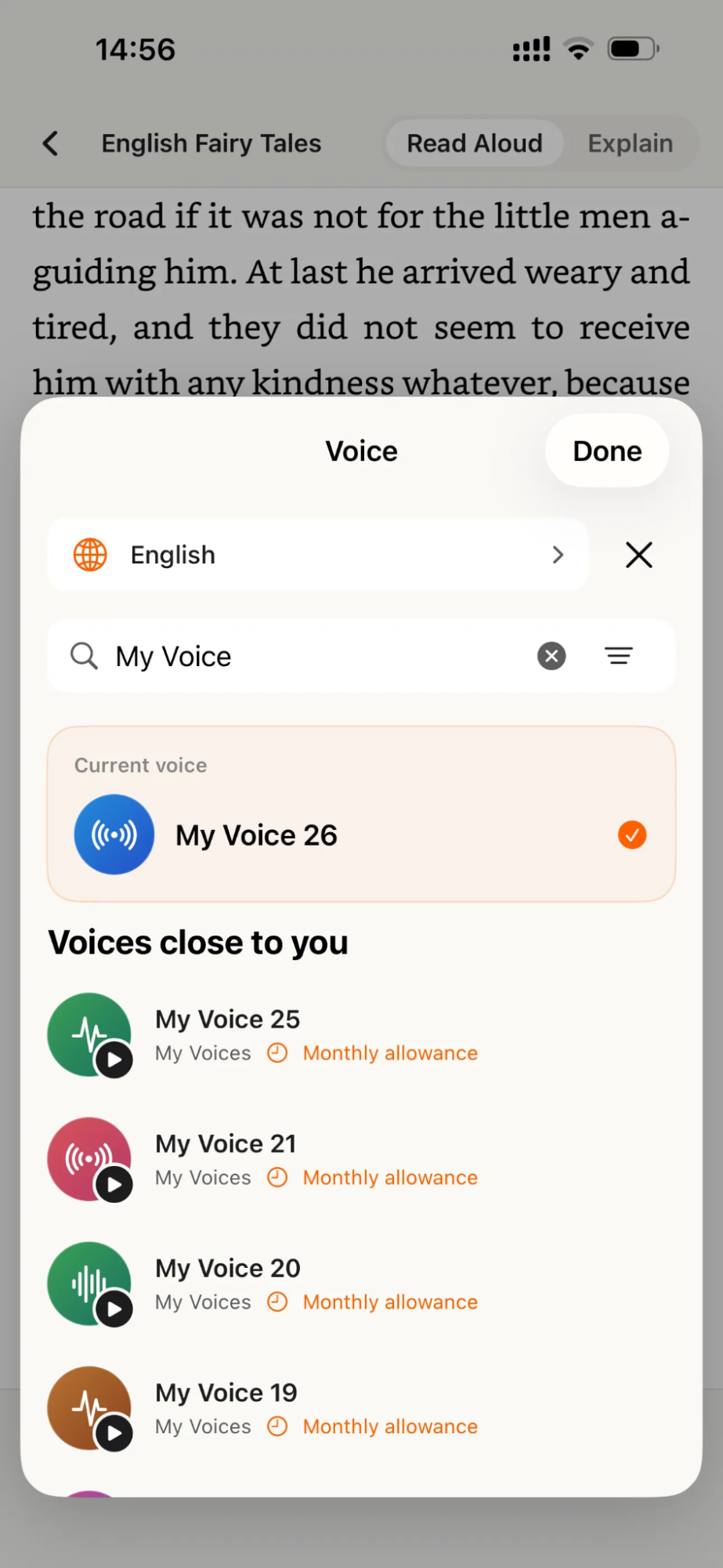
A personal voice selected in CastReader’s iPhone reading controls.
The listening pass is still your judgment call. A repeated word may be a deliberate motif, and an unusual rhythm may belong to the character. Audio helps you notice those choices; you decide which ones serve the story.
Make the second pass selective. Revise the passages that raised a clear question, then listen to those sections again. You might shorten a repeated description, clarify a speaker, or keep a long sentence because its rhythm suits the scene. The point is to connect each change to something you noticed in the text.
Return to the page with a few specific questions rather than an instruction to change everything. Perhaps a transition needs one sentence of context, a speaker needs to be clearer, or a repeated image should stay because it carries the scene. A listening pass makes those choices audible. The next editing pass decides what the story needs.