

























































The K-State Athletics video production team incorporated generative artificial intelligence into the production of its revived “Crazy Train” graphic this football season. While some students said they enjoyed the updated game day tradition, others questioned the department’s decision to use AI when it has an in-house production team.
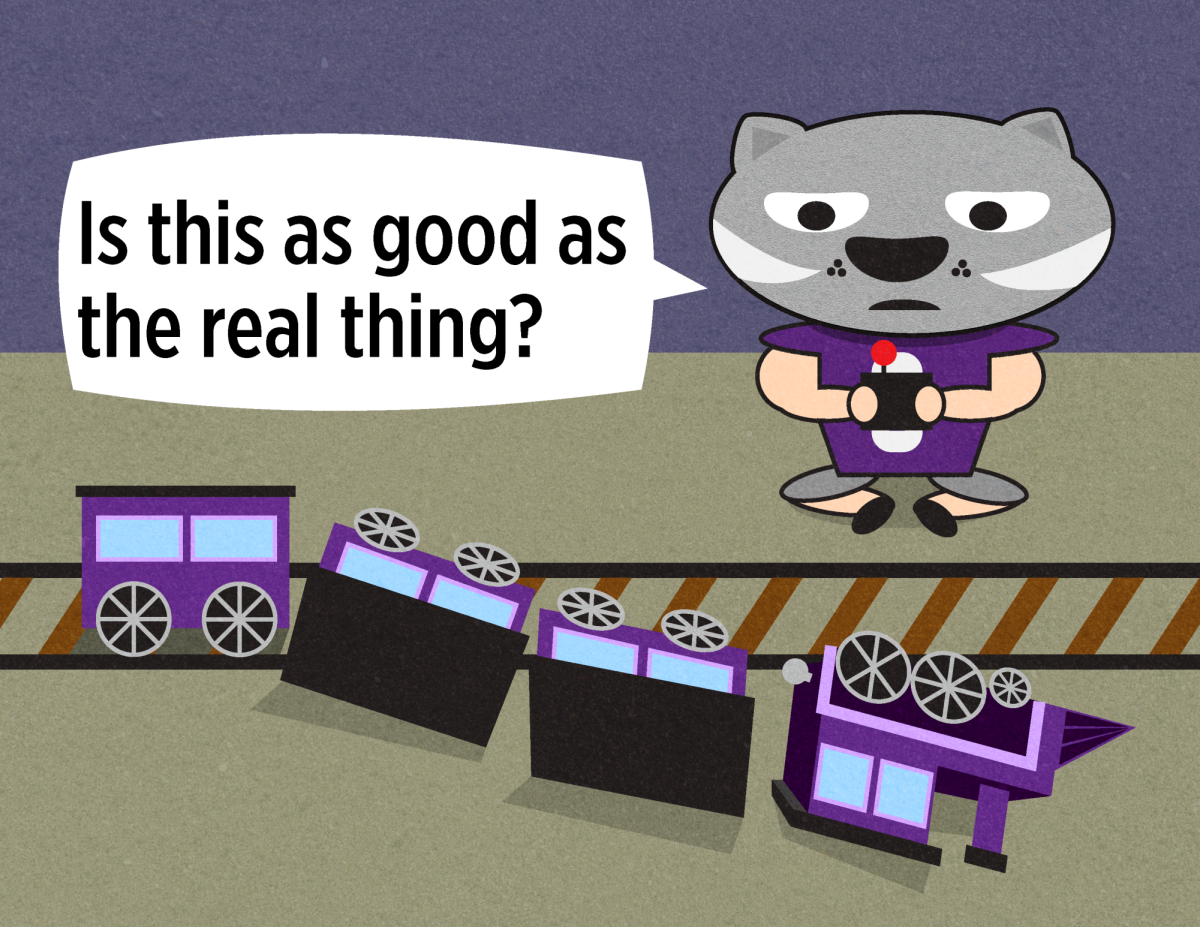
The updated graphic, which the team produced using a combination of AI tools, green screen footage and digital production software, features a purple train with a wildcat head on the front. The train travels through a tunnel, advancing through iconic locations in Manhattan such as the Flint Hills, Manhattan Hill, Aggieville and Anderson Lawn.
The visual also includes clips of previous K-State football highlights while Ozzy Osborne’s “Crazy Train” plays in the background. The sequence ends with the train crashing into the opposing team’s football helmet, destroying it before players run onto the field.
Andy Liebsch, senior director of video services for K-State Athletics, said the project began with meetings between video services, marketing and communications staff last spring. The department wanted to embrace a more traditional identity for the football program and bring back elements of the previous stadium atmosphere.
“We knew people liked the Cat Train and liked the Willie skit and some of those kinds of things,” Liebsch said. “So we were trying to bring back some of those traditions that we used to have and kind of bring them back into our game day experience.”
Outside 3D production groups in the Kansas City area created previous versions of the “Crazy Train” graphic. This year’s version was produced in-house using several digital production tools.
“We used some AI stuff,” Liebsch said. “We used stuff that we shot on green screen, After Effects and Premiere, the Adobe Suites, some Cinema 4D to do some of the compositing. We used everything at our disposal to make it happen.”
Liebsch confirmed that parts of the train incorporated AI, while the department created other elements through its own compositing work.
“AI is just a tool, like any other tool,” Liebsch said. “The parts that are AI are just using another tool like anything else.”
Liebsch said the department was pleased with the final product, including the updated design of the train.
Some students noticed elements of the graphic that they believed looked AI-generated.
Cole Teeter, senior in industrial engineering, said he enjoyed the graphic and thought it added to the atmosphere at football games.
“It was cool,” Teeter said. “It was something different. I enjoyed it. It got me hyped up.”
Teeter said he could recognize characteristics that made the graphic appear AI-generated, including what he described as an abundance of solid colors. However, he said the use of AI did not negatively affect his opinion of the graphic. Teeter said he viewed it as a practical decision.
“I think it’s smart on their part,” Teeter said. “They can get the job done quicker.”
Mari Hernandez, sophomore in psychology, said she believes the department could have utilized traditional animation instead of relying on AI.
Hernandez said she understands that AI can be useful, but questioned why a department with an established video production team would choose to incorporate it into the graphic.
“They have their whole production team, their whole video team,” Hernandez said. “I think they should be capable of doing things like a much better type of animation.”
Liebsch said the department does not have a formal policy specifically outlining what it can and cannot use AI tools for in the video production process.
He compared the use of AI in video production to using it as an additional tool when writing a paper, saying the technology does not independently create the finished product.
“There’s parts that you are still creating,” Liebsch said.
He said that the production process involves combining AI with original images, other digital tools and the staff’s own creative work.
As generative AI becomes more common in digital media production, the return of the “Crazy Train” graphic provides an example of how the technology is being incorporated into university athletics content, while also raising questions about creative processes among student viewers.