










































































K-State utility and security teams make campus updates and improvements every year to ensure K-State students, faculty and staff can roam school grounds worry-free. Recent updates include repairing sidewalks, outdoor installations and implementing new blue light phone models.
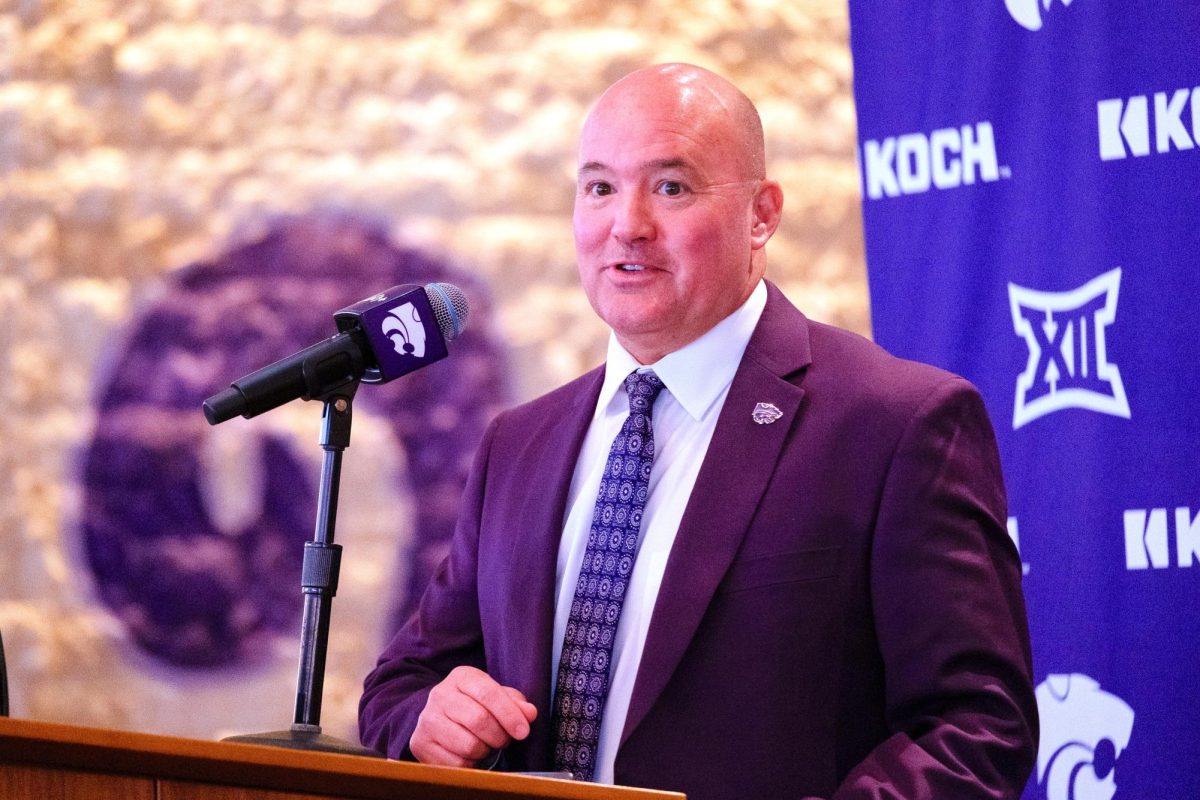
One factor in keeping campus free of hazards and easily accessible is consistent sidewalk renewal and improvements across K-State. Tim Brunner, director of utilities and plant management, said people feeling safe when walking around campus is a “number one priority.”
“Anything outside, if it comes to emergency phones, walkability, driveability of campus, lighting … that’s always our top priority because we want everybody to feel safe when it’s dark,” Brunner said.
Brunner’s team assesses facilitative needs around campus every year for completion before the next fall semester. Brunner said projects within the last year have included repairing multiple sidewalks, stairs, crosswalks and alleyways around campus.
“Every year … I do a walk around campus, check for cracks, sunken concrete, anything that can be a trip hazard, anything where a wheelchair could have a hard time getting across, any gaps, any holes in the concrete that can be patched,” Brunner said. “Then I put them on a map and build a scope for it.”
Much of Brunner’s job is ensuring campus accessibility for people with mobility impairments, such as maintaining handicap entrances on sidewalks.
“We’ll make sure that [handicap sidewalk entrance requirements] are there so the handicapped people can get traction while they’re coming up the sidewalk,” he said. “So anything that has to do with the safety for … anybody that has a disability, we always look at that stuff first and try to take care of it.”
Brunner said upcoming facilitative projects include repairing stairs and installing a sidewalk from the loading dock of Ackert Hall, repairing stairs at Van Zile Hall, finishing unfinished pieces of sidewalk and repairing general sidewalk damage.
Another effort to improve campus safety includes replacements and updates to blue light phones scattered across K-State grounds. Brett Robinson, associate director for physical security and access control, said K-State is opting for a newer version of blue light phone poles featuring Verkada cameras.
“What these poles do is it has a Verkada intercom and then a Verkada camera on top of the blue pole,” Robinson said. “We also put a dedicated circuit in there so that blue light stays on all the time … then when you push the button, you are connected to dispatch at K-State PD, and then they can see you on the phone talking and kind of see if you’re in distress or just asking for information, then the other camera looks at all angles around that pole.”
Robinson said there are currently three of these year-old blue light poles on campus, located by Ackert Hall, North Martin Luther King Drive and by Campus Creek Road. The Verkada intercom is able to interpret up to 15 different languages between dispatch and users, he said.
In addition to the new blue light Verkada poles, campus features a variety of different emergency phone systems, ranging from newer to older models. Robinson said he plans to replace four outdated phones.
“Right now, there’s about 48 blue phones on campus,” Robinson said. “There’s 12 in the K-State parking garage, about 39 that are actually the blue poles that you see around campus and then there’s about nine that are inside buildings at different levels. … The four that I want to replace are by A1 and A2 parking lot … one by the College of Business on Vattier Street, the third by [McCain Auditorium] and the [Marianna Kistler Beach Museum of Art] … and then the fourth one between Cardwell [Hall] and Waters [Hall].”
An additional resource Robinson said is available is the K-State Safe app, which can connect people with dispatch as well as provide alerts and maps featuring the location of emergency phones.