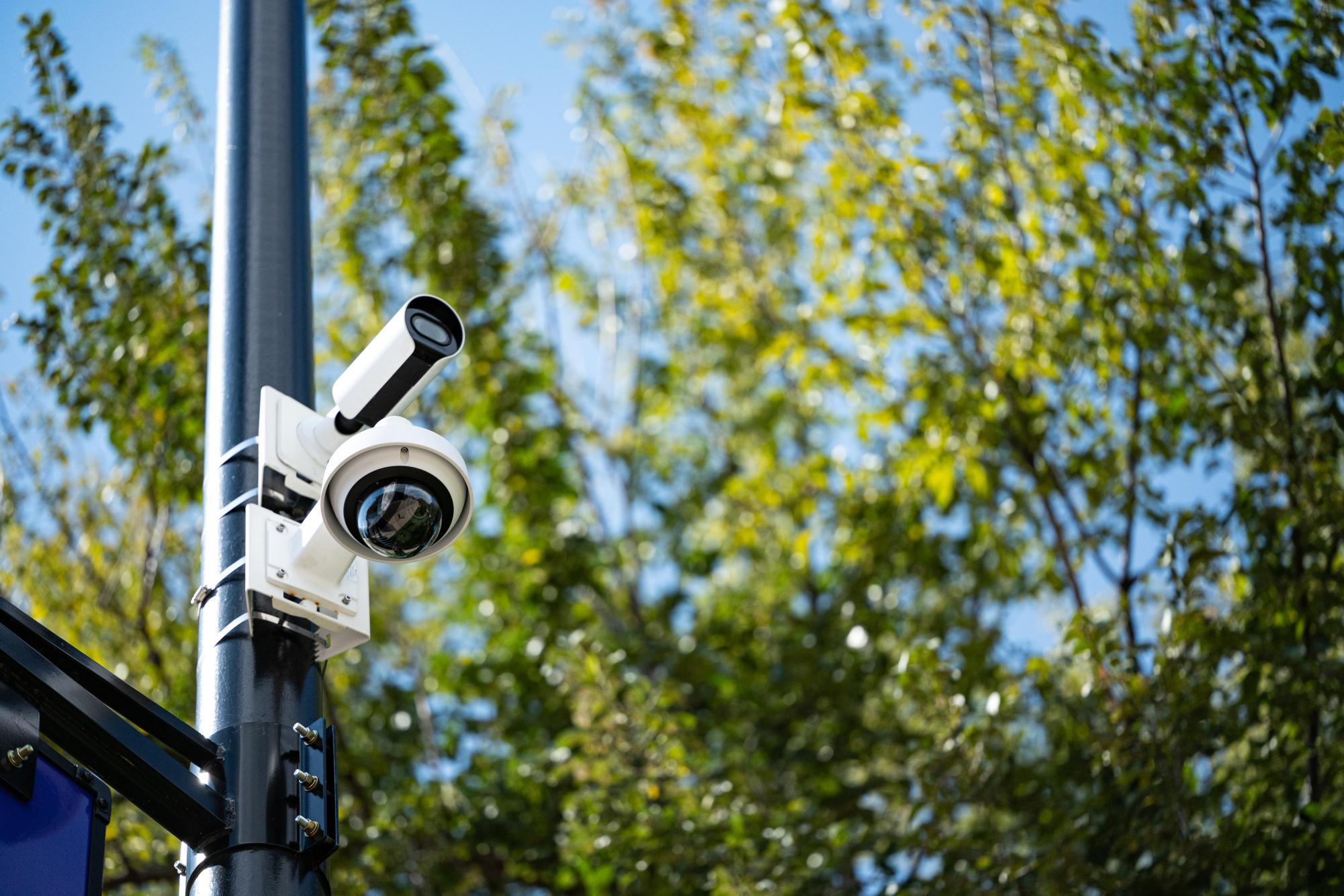
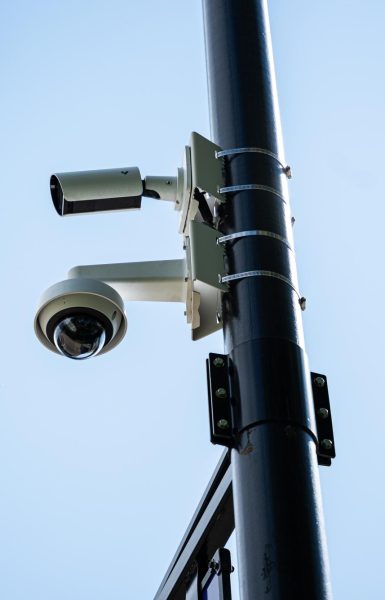
Sheathed in white and marked with a gray letter V, 386 Verkada cameras dot K-State’s Manhattan campus.
The cameras are live-view and have built-in artificial intelligence, allowing users to watch them in real time and search their memory for “relevant footage in seconds with powerful search tools for people, vehicles, and motion,” according to Verkada’s website.
K-State has been installing Verkada cameras since 2022 as part of an effort to consolidate security access, increase campus safety and protect student property. However, the cameras have drawn mixed feelings from students amid national concerns about other AI-powered camera systems.
Where are they?
Brett Robinson, associate director of physical security and access controls, said many of K-State’s Verkada cameras are in parking lots and major pedestrian areas, while others face building entrances. The rest are located inside buildings, not including residence and dining halls. He said the installation process started with the B2 parking lot north of the Derby Community, before moving to other spaces on campus.
“We’re kind of going in stages,” Robinson said. “We hit areas like A28 parking lot was a big one because it has dorm parking for Wefald Hall, and there’s … people that park there for engineering, Ward Hall and Ackert. We moved to pedestrian malls too, to Mid-Campus [Drive] and Martin Luther King [Jr.] Drive, and then obviously Anderson Lawn [and] Goldstein Circle, which is by [The Marianna Kistler] Beach [Museum of Art] where they have major events.”
A deferred maintenance fund finances the majority of the camera placements, but Robinson said the Student Governing Association specifically funds placements near bicycle racks in the Kramer Community.
“Those are the bike racks that are hit the most as far as thefts,” Robinson said. “So we have a camera over there now with student funding, and also we’re getting three more put up over there. … So that’s where some of the student dollars have gone to is to help protect their property.”
What are they used for?
Though AI-powered camera systems like Flock have recently faced public scrutiny over concerns about misuse and privacy violations, Robinson said K-State’s Verkada cameras are for protecting students, not tracking them.
“We’re not here to monitor,” Robinson said. “It helps PD [the K-State Police Department] have an extra eye on events, on the main campus ways at crosswalks, parking lots where accidents do occur; people get hit at crosswalks. So we just have that … technology there to help us.”
If there is a campus incident, Brandon Chance, chief risk and safety officer and associate vice president of the Department of Risk and Safety, said K-State can use the cameras to monitor the situation and provide information to first responders before they arrive.
Incidents K-State’s Verkada cameras have already helped solve include property theft and vandalism.
“There’s been a lot of bike thefts on campus, and some of these bikes now are approaching the three-grand mark, e-bikes and stuff, so that [Verkada technology] has come in handy,” Robinson said. “We had some vandalism occur in that B2 parking lot. … Somebody walked out of a dorm and ripped off 10 or 12 windshield wipers off the back of cars, and then they [KSUPD] were able to catch that person and make them pay all the repairs.”
Chance said K-State also uses the cameras to monitor weather events and campus conditions like downed trees and snowfall, which can aid in campus-wide decisions.
Who can access them?
The only individuals who have full access to K-State’s Verkada cameras are Robinson and senior members of the K-State Police Department, Chance said. After that, he said a hierarchy of controls is in place, where others may have access to some cameras, but only if Robinson and KSUPD determine that there is a “bona fide need for that.”
“For example, the band director may have view-only access to the couple [of] cameras in the public areas of the band hall, or a facilities person in their own building will have access to only their cameras,” Chance said.
Robinson said Verkada itself doesn’t have access to K-State’s cameras and that he has to manually grant the company access if there is an issue that needs troubleshooting. He also said K-State owns all of their camera data and that every camera on campus has a 60-day data retention period.
Why have they been installed?
Before K-State installed its Verkada cameras, Robinson said there weren’t any exterior cameras on campus that KSUPD could readily access. Instead, he said the only available cameras were across 15 different systems, with many tied to different colleges, which made reviewing footage inconvenient.
“Some of the times, it would take 80 man-hours just to watch that video,” Robinson said.
After SGA issued a request for proposal in 2020 to find a vendor for new exterior cameras, Robinson said K-State ultimately chose Verkada due to the cameras’ ability to store memory that KSUPD can quickly access in the event of a campus incident.
The ultimate goal, Chance said, is to consolidate K-State’s security camera system to make it easier to keep campus safe.
“We’re trying to bring One K-State, truly One K-State, for safety and security with camera systems,” Chance said.
What do students think?
Among K-State students, feelings about Verkada cameras on campus vary.
Carson Cline, sophomore in athletic training and rehabilitation sciences, said he’s never noticed the cameras, but supports their presence on campus.
“I think it’s a good thing,” Cline said. “They’re not bothering me or anything. … It helps out [that] if there is an issue, they can just pull up camera footage and look.”
Other students, like Jonas Pepin, sophomore in accounting, believe K-State shouldn’t invest money in the technology or increase the number of cameras on campus.
“In my opinion, they’re probably spending way too much money on them for a system that’s not fully developed yet,” Pepin said.