























































































































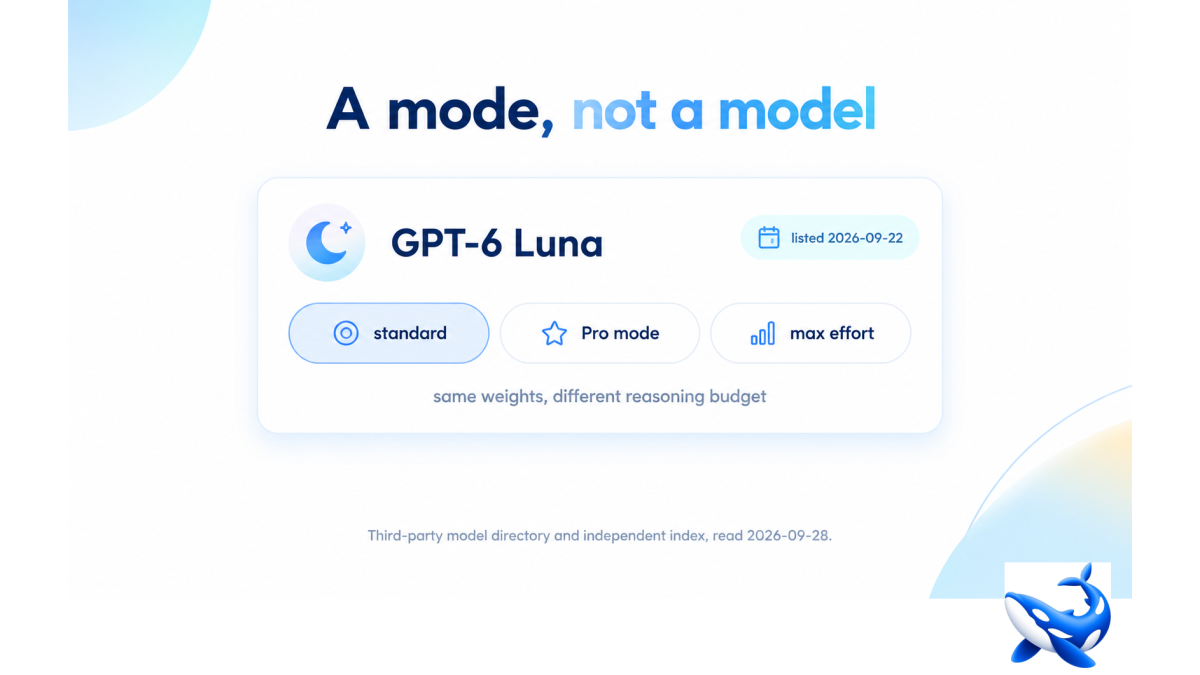
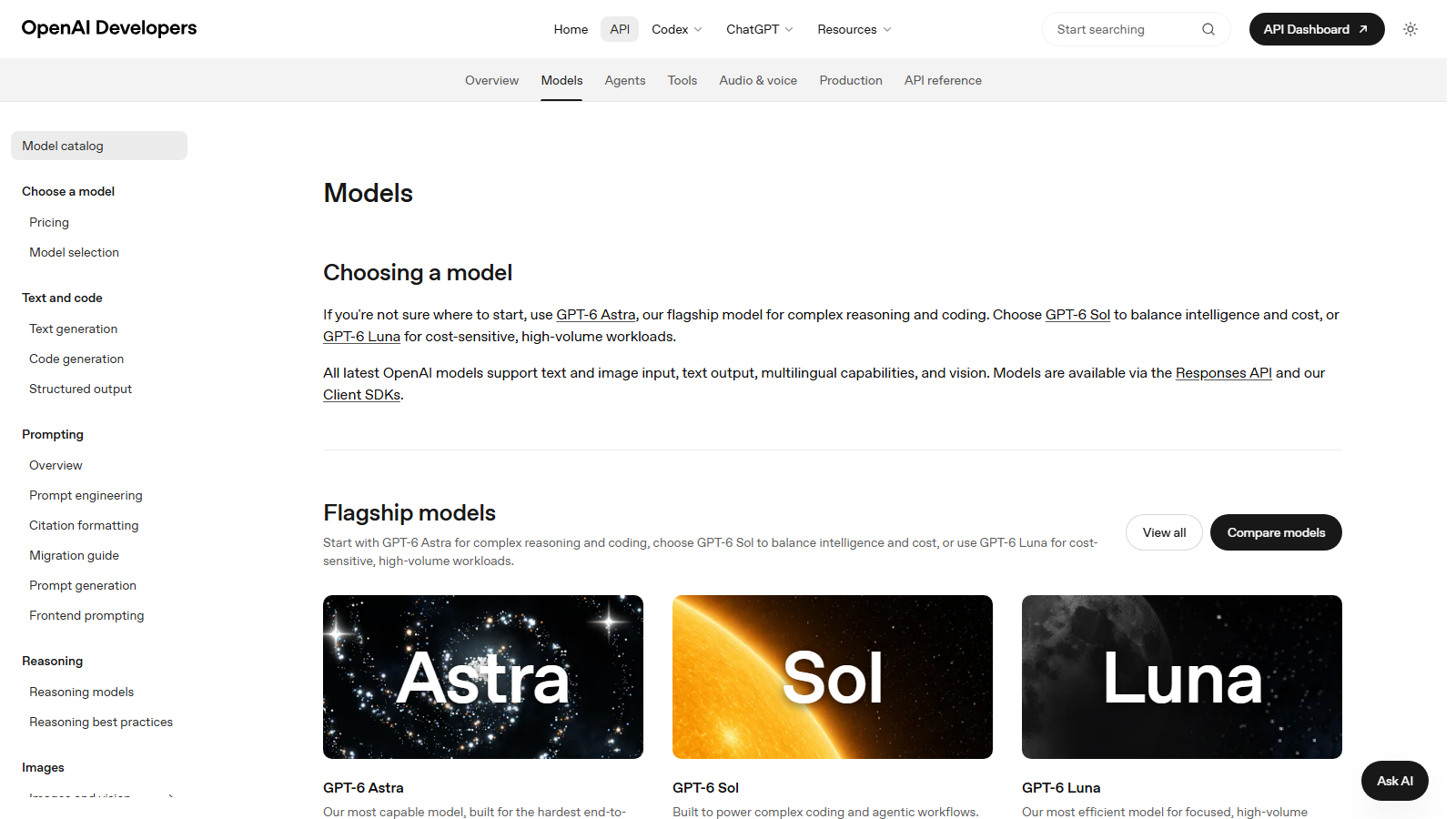
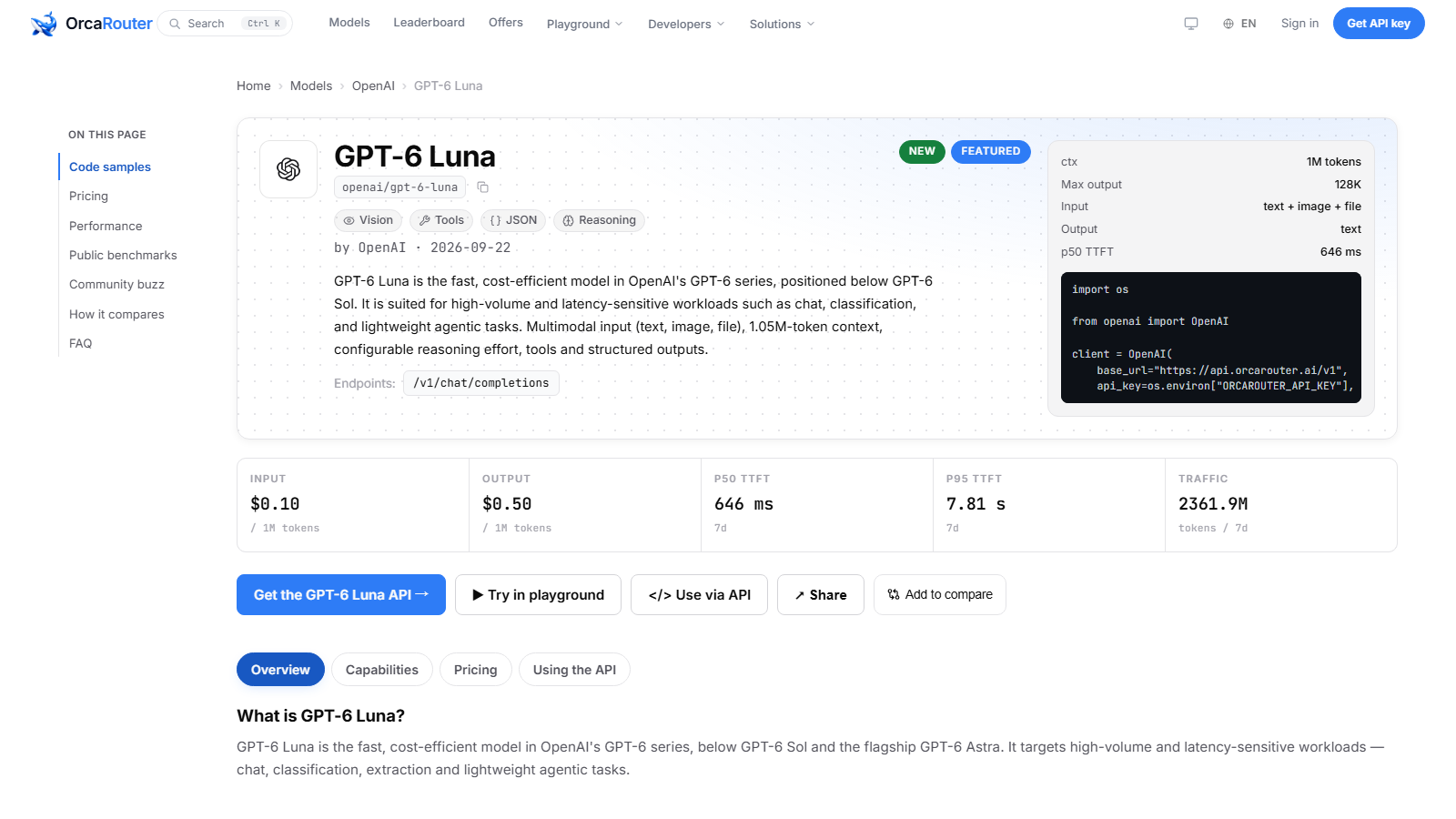
The most expensive mistake in reading this month’s latest AI model releases is a naming one. A label arrived on 22 September 2026 that looks like a product tier — a model name with “Pro” appended — and it is not a model at all. It is a reasoning mode of an existing model: a setting that tells the same weights to spend more thinking tokens before answering. Nothing was retrained. Nothing new was released. And because the label sits in a catalogue row beside genuine new models, it will be counted as one. On OrcaRouter the GPT-6 Luna page — one of the latest AI models in our catalogue — carries its rate and its latency telemetry, and since the Pro setting is one call against that same row, it is worth being clear about what changes when you select it.
What a reasoning mode actually changes
A reasoning model produces intermediate tokens before its answer. The number of those tokens is a budget, and the budget is a knob the caller can turn.
Turn it up and the model explores more, backtracks more, and checks itself more. Turn it down and it answers faster from its first instinct. The weights are byte-for-byte identical throughout; what varies is how much computation is spent on the answer.
Give that knob a product name and put it on a price list, and you have a Pro tier. The reason vendors do this rather than shipping it as a parameter is commercial rather than technical: a named option is easier to sell, easier to price, and easier for a buyer to reason about than “set reasoning effort to high”. The reason to be careful is that a named option also reads as a different model, and that is the misreading to avoid.
Why the distinction is worth money
If the mode is just a setting on the same weights, why does it deserve its own row and its own rate?
Because reasoning tokens cost real compute. A model that thinks for four thousand tokens before answering has spent four thousand tokens’ worth of inference, and the provider pays for that whether or not the tokens are visible in the answer. Charging a higher rate for the high-effort mode, or billing the hidden tokens as output, is not a markup on the same goods — it is the correct price for a genuinely more expensive computation.
Which means the comparison you should make is not “base versus Pro” but “cheap sparse thinking versus expensive thorough thinking”. And that comparison has a clean form: what does it cost you to get an acceptable answer, including the cost of the retries you avoid because the thorough mode got it right the first time?
If your task is a formatting conversion, the thorough mode is pure waste. If your task is a subtle inconsistency in a long document, the cheap mode may fail three times before you stop trusting it, and the expensive mode is the cheaper path. The mode is a tool for buying accuracy with latency and money, and it should be selected per task rather than globally.
The configuration label on the score
The independent index we checked on 28 September 2026 records 37.26 for the base model, under a configuration labelled `max`. That is the highest reasoning setting, not the default.
This is the part that is routinely lost. A score published without its configuration is not a property of the model — it is a property of one point on the effort dial. The same weights at a lower effort will score lower and answer faster, and the difference between the `max` result and a default result is often larger than the gap between two adjacent models in the table.
Two practical habits follow. When you read a score, find the configuration and write it down beside the number. And when you compare two models, check whether their published scores were produced at comparable settings — otherwise you are comparing an effort level on one side with a different effort level on the other and calling it a model comparison.
Where the mode sits in our own catalogue
We list the base model, and our model page for it records both the per-token rate and a p50 time-to-first-token measured on our own production traffic. That latency number is the useful anchor here, because a reasoning mode’s cost is not only money: it is the wait before any output appears.
If the base model’s median time-to-first-token is already in the seconds, a mode that roughly doubles hidden reasoning will roughly double the wait before the first visible token, and the answer will be better. Whether that trade is acceptable depends entirely on whether a human is watching. For a background job, take the thorough mode and forget the latency. For an interactive surface, the cheap mode plus a good prompt often beats the expensive mode plus a waiting user.
That is the whole decision, and it is a decision about your product rather than about the model.
The general rule for reading a catalogue
Three shapes now appear in model catalogues and all three look like a new model at a glance.
There is a new set of weights, which is a genuine release and can be compared on scores. There is a serving tier of existing weights, sold under a new name at a higher rate, which can be compared on price per token and latency. And there is a reasoning mode of existing weights, sold under a new name, which changes the answer quality and the token count for the same weights.
Distinguishing them takes about thirty seconds per entry: read the price, read whether the vendor describes the change as new weights, and look for a configuration label on any score. The payoff is that you stop budgeting for models that do not exist as separate products, and you stop assigning one price to a model that can be called at several.
The practical action is small. Wherever your configuration names a model, make it name the mode as well, and record which mode each production route uses. Once one model can be billed at more than one rate, a cost report that lists only model names is describing something that is no longer true.
Sourcing note: The base model’s listing date of 22 September 2026 and the existence of a separately named high-effort reasoning mode of the same model were read from a third-party public model directory on 28 September 2026. The independent index figure of 37.26, in a configuration labelled max, is that index’s number for the base model at its highest reasoning setting, not at the default. The model’s per-token rate and its p50 time-to-first-token are from OrcaRouter’s own model page read on 28 September 2026 and are our production telemetry, which moves over time. The characterisation of the Pro name as a reasoning configuration rather than a retrained model is our reading of the vendor’s own description of the option. The arguments about per-task mode selection, hidden-token billing and the effect of reasoning budget on time-to-first-token are editorial framing rather than measured results. No price is invented for the mode itself. This article names no competing platform and describes none.