












































































































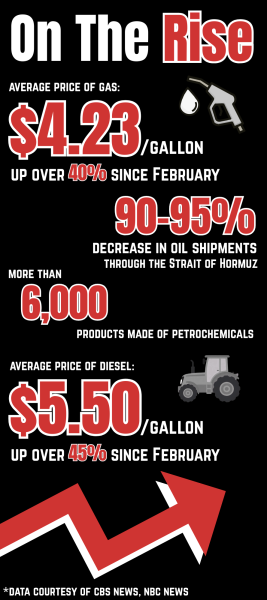
As the United States surpasses the one-month mark of its conflict with Iran, oil prices are at their highest levels since the summer of 2022.
The spike is the result of a significant decrease in oil shipments through the Strait of Hormuz, where about 20% of the world’s oil passes through. Located at Iran’s southern coast, Iranian threats of drone strikes, missiles, mines and boat attacks have decreased oil shipments through the strait by 90-95%, causing the average price of a barrel of oil to increase by more than 50%, according to CBS News.
Lance Bachmeier, professor of economics, said the recent spike in oil prices is affecting costs across the board.
“The direct effect that everybody’s going to notice, you just go to the pump, and you’re paying considerably more,” Bachmeier said. “For a lot of people that drive, that’s costing them a lot. And I haven’t recently booked any plane tickets, but I’m guessing that that’s feeding through. So, for instance, college students that have to book a flight home, they’re gonna probably see a much higher price because of that as well. But then it’ll feed into things like grocery prices because … quite a big chunk of the cost of food is transportation.”
The effects also ripple into agriculture, increasing costs for farmers nationwide and significantly affecting the economies of major agricultural states like Kansas.
“You’ll see higher costs of mainly diesel, as well as fuel, so that will increase input costs for farmers with spring planning,” Mackenzie Malson, senior in agriculture economics and global food systems, said. “Right now, they’re [farmers are] doing fertilizer and pre-emerge pesticide application, so those costs will be higher because of the fuel prices being higher. And you also will have higher prices for chemicals and fertilizer, due to higher shipping costs for those items … There’s so many jobs related to it, and it’s already a very thinly-margined industry, and so those effects really affect the economy of Kansas.”
Besides raising costs, Bachmeier said a rise in oil prices can also accelerate inflation, making it harder for college students to find jobs.
“One of the traditional reasons we care about oil price increases and gas price increases [is because] they cause inflation,” Bachmeier said. “That causes the Fed [Federal Reserve] to tighten monetary policy. They can have these effects where they make it a lot harder to find jobs. And the group that’s probably most affected by that would be new college graduates because they don’t have much job experience. … So somebody that’s a junior or senior, they may want to keep in mind that maybe the job market’s not going to be so good, potentially the next couple years.”
Young Democratic Socialists of America at Kansas State conducted a campus-wide wage survey beginning in the fall of 2025. According to Daniel Robertson, senior in computer science and co-chair of YDSA at K-State, about 30% of respondents reported being completely self-supporting on their income. The majority of that percentage, Robertson said, also reported that their wages do not cover most of their expenses, making a rise in prices even more harmful.
“When it comes to rising oil prices and rising gas prices, it feels like everything’s out of control,” he said. “And that’s really frustrating for most students and me as a college student. I’m just trying to pay my bills, get tuition paid for, pay rent, food and all of that. And now I have this extra expense on top of it, not to mention that my government’s making decisions that I certainly don’t agree with. You know, what am I supposed to do as the average college student?”
Other students, like Silas Thoennes, senior in political science and president of Young Americans for Freedom at K-State, believes increased prices are a worthwhile temporary sacrifice for long-term safety from foreign adversaries.
“Given his [President of the United States, Donald Trump’s] decisive action in Iran … I think it remains to see whether this is beneficial to the American people,” Theoness said. “Up to this point, I think it absolutely is. … I think personally, if you were to do a cost benefit analysis, and this is very debatable, but I think it’s worth it for the American people to pay a dollar, $2 at the max, higher at the pump for a month, two months, maybe, to see one of America’s greatest enemies and adversaries removed from the global stage permanently.”
Bachmeier, however, believes Americans will experience higher prices for much longer.
“If you look at the future’s price [of oil] for the end of the year, last time I saw, it was about ¢60 higher for the end of this year than it was in January,” Bachmeier said. “So I would say that, at least according to the markets, it’s expected to be considerably higher for the next year.”