















































































































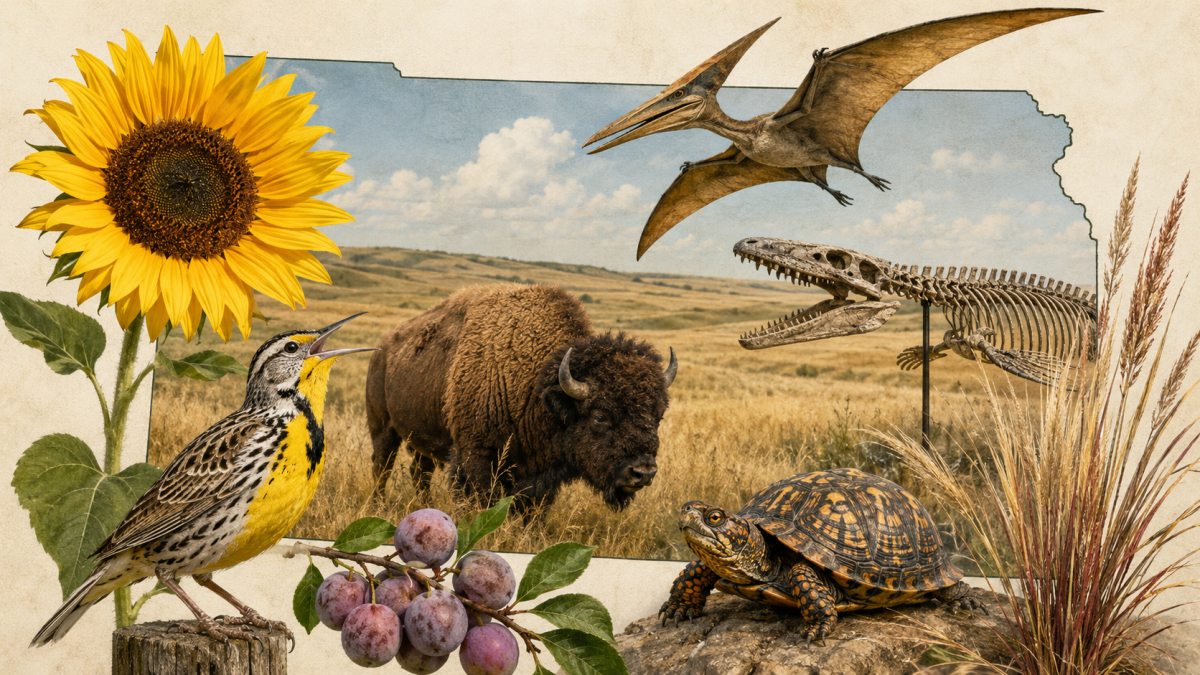
About six miles south of the K-State campus, a herd of roughly 300 bison moves across the Konza Prairie Biological Station, a tallgrass preserve the university’s Division of Biology has managed since 1971. The American bison is the official state animal of Kansas. The little bluestem under its hooves is the official state grass. Two state symbols share the same field, and most drivers on K-177 pass both without a second look.
Lined up state symbols by state, a lot of the country’s emblems blur together. Dozens of states reach for the same birds, trees and flowers. Kansas gets interesting where it stops sharing.
A name borrowed from the land
The word on the preserve sign is a clue. “Konza” is an older spelling of Kaw, or Kansa, the people who lived along these rivers before the state took their name. The bison became the state animal in 1955, decades after it had been hunted nearly off the same prairie it now represents.
K-State researchers later spent more than thirty years at Konza documenting what happens when the animal returns. Bringing bison back roughly doubled plant diversity on the preserve, according to a 2022 study led by university biologists.
Most of the unusual entries on the list of kansas state symbols come from the ground rather than the surface. Kansas sits on some of the richest fossil beds in the country, and the Legislature has leaned into that.
Three official fossils
Most states never name an official fossil. Kansas named three.
In 2014 lawmakers designated Tylosaurus, a marine lizard that grew past 40 feet, as the state marine fossil. The same law named Pteranodon, a flying reptile with a wingspan over 24 feet, as the state flying fossil. Both animals lived when a shallow sea cut North America in half, and chalk beds in the western part of the state have produced some of the most complete skeletons of either creature on Earth. Neither one was a dinosaur, a point state museum staff have had to make many times.
In 2023 the state added a third, and that one was a dinosaur. Silvisaurus condrayi, the woodland lizard, became the official state land fossil. It is the only dinosaur ever recovered from the Dakota Formation in Kansas, a roughly ten-foot armored plant-eater first spotted in 1955 by a rancher checking his cattle.
One state fossil is rare. A set covering ocean, sky and land is something almost no other state has done.
Rocks with backstories
The minerals are oddly specific too. In 2018 Kansas named galena, the lead ore that built mining towns in the southeast corner of the state, as the official state mineral. The same year it picked Greenhorn limestone as the state rock, the pale stone stacked into fence posts across the Smoky Hills where timber was scarce. Settlers fenced their land with rock.
That second designation started with a fourth grader. Casey Friend, of Overland Park, ran the campaign that carried Greenhorn limestone through the Legislature, proof that moving a state statute does not require a lobbyist.
Amber, wine grapes and a wild plum
The gemstone tends to get a laugh. Kansas chose jelinite, a fossilized tree resin pulled from its Cretaceous rock. It is essentially Kansas amber, petrified prehistoric sap from a state that was underwater at the time.
The list keeps wandering into territory other states avoid. In 2019 the Legislature named two official wine grapes, Chambourcin for red and Vignoles for white, a nod to a small but persistent Kansas wine industry. The state fruit, added in 2022, is the sandhill plum, the tart wild plum that grows along fence lines and gets cooked into jelly across the western half of the state.
There is even an official soil, Harney silt loam, which sounds like a punchline until the role of Kansas farmland in feeding the country comes up. The dirt is part of the reason.
An honest inventory
What ties the list together is how local the choices are. Many states settle for a generic mineral or a popular songbird and move on. Kansas keeps reaching for things that only make sense here: the sea monster in the chalk, the amber in the riverbank, the plum on the fence line, the grass on the prairie south of Manhattan.
The oldest symbol sets the tone. The state motto, Ad astra per aspera, has been on the seal since 1861. It means “to the stars through difficulties,” and it was chosen during a violent fight over whether Kansas would enter the Union free or enslaved. It is heavier than most state slogans, and it has aged better than almost any of them.