























































































































When advertising and brand strategy work together, businesses start building steady momentum. Growth comes from sharp targeting and cutting-edge brand strategies that keep a company recognizable wherever buyers encounter it.
More than ever, today’s buyers move between search, social media, streaming platforms, podcasts, review sites, email, and word-of-mouth before they ever make a decision. If a business shows up inconsistently or only invests in short-term conversion tactics, it leaves money on the table.
Advertising still does one job extremely well
Advertising creates reach by putting a message in front of people who may not know your company yet, or who know it only vaguely. That top-of-funnel exposure matters very much, especially in crowded categories where buyers have too many options and too little time.
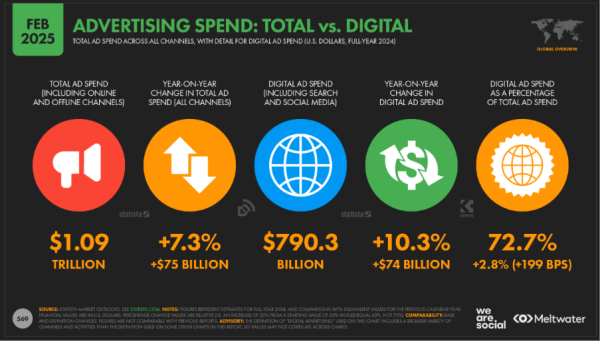
More importantly, businesses still believe advertising drives results, and the fight for attention is more intense than ever. Global ad spend reached close to $1.1 trillion in 2024, and digital channels accounted for 72.7% of ad investment worldwide.
But, reach alone is not enough. Plenty of companies buy traffic without creating any lasting business value. They get seen, but they do not get remembered. Or worse, they get remembered for the wrong reasons because the ad promise and the brand experience do not match.
Brand strategy changes that equation.
Turning attention into memory
A good ad can win a click, but a good brand can win preference. Brand strategy helps people understand why they should choose you over another option that looks similar on paper. It shapes your positioning, your messaging, your visual identity, your offer design, and the tone people associate with your company.
Gartner found that 84% of business leaders and employees believe their company identity must change significantly to achieve strategic objectives, and the same research found that leaders who report strong audience understanding of their company’s evolution are 1.4 times more likely to surpass revenue objectives. So, when the market understands your story, growth gets easier.
Modern growth depends on both
Some companies treat advertising and branding like separate departments with separate goals. One team wants leads now, while the other wants long-term awareness. However, the sooner a company realizes that those goals support each other, the better.
Consumers tend to trust recommendations from people they know more than any other channel, and strong branding increases the odds that paid media turns into repeat business instead of ending at the impression.

[Source: Nielsen]
Effective advertising gets attention, but brand strategy improves what attention is worth.
Importance of personalization
Personalization has become part of the brand experience itself. Customers do not want every message to sound mass-produced, but that does not mean every brand should chase hyper-targeting or intrusive data use.
Smart companies design campaigns that feel relevant without feeling invasive. They segment well, adapt, use first-party insights responsibly, and make it easier for buyers to feel understood.
When that happens, branding becomes part of conversion performance.
Where businesses get it wrong
The most common mistake is treating ads as a substitute for branding or vice versa.
A business may pour money into paid campaigns while sending traffic to weak pages with generic messaging. Another may invest heavily in brand storytelling but fail to distribute it in places where buyers can actually see it. Both approaches limit growth.
A few other problems show up often:
- Chasing every new platform without a clear message
- Producing content that gets attention but does not fit the brand
- Measuring only clicks and ignoring quality, recall, or downstream revenue
- Changing tone or visuals so often that recognition never has time to build
- Talking about the company in ways that customers do not care about
Growth gets easier when the market understands you
This is the core idea behind effective advertising and advanced brand strategy. Growth is not only about pushing harder, but about making each impression and each touchpoint work harder.
Advertising gives a business the ability to show up, while brand strategy gives it the ability to mean something once it does. Put together, they improve visibility, sharpen differentiation, strengthen trust, and make conversion more likely across the full buyer journey.
In a noisy market, that combination is a competitive advantage. The companies that treat advertising as a growth lever and brand strategy as a growth system are usually the ones that stop relying on one great quarter and start building something more durable.