











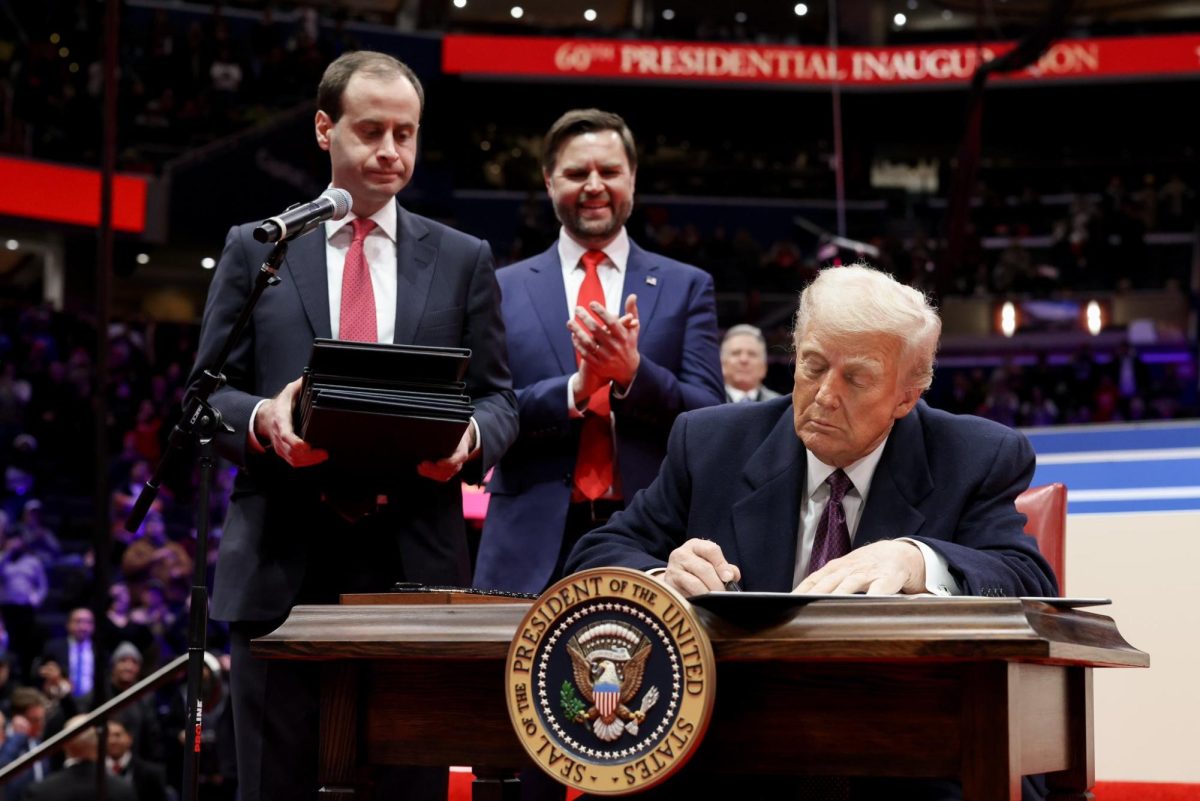


















































































In an interview with Politico in December 2025, President of the United States Donald Trump graded the current U.S. economy “A + + + + +.”
But when taking a closer look at some of the president’s most persistent economic claims, a very different, much bleaker reality is revealed for the American consumer.
Trump inherited the highest inflation in U.S. history
In his address to the nation on Dec. 17, 2025, Trump claimed, “When I took office, inflation was the worst in 48 years, and some would say, in the history of our country.”
A bold claim like this has not been uncommon during the first year of Trump’s second administration. The president has made numerous comments blaming the Biden administration for issues ranging from immigration to the rising prices Americans are seeing in the grocery store.
The fact of the matter, however, is that this specific claim regarding inflation is easily debunked. A quick Google search will take you to the official U.S. Bureau of Labor Statistics website, where their 12-month inflation percentage graph shows that average inflation for all items in the consumer price index has sat between 2.5% and 3% since June 2024, well before Trump’s inauguration in Jan. 2025.
Additionally, while it is true that inflation spiked during the Biden administration — peaking at 9.1% in June 2022 — the jump corresponded directly with a global inflation surge triggered by the COVID-19 pandemic, when global inflation reached 8%, according to the World Bank Group.
Trump has also made claims that the current administration has “defeated inflation,” and that prices are coming down; a puzzling pair of statements considering that any amount of inflation above 0% means prices are going up.
Tariffs are bringing in billions from foreign countries
Trump has made numerous claims that the tariffs his administration imposed on dozens of countries are bringing billions of dollars into the U.S. However, while it is true that the tariffs are indeed raising billions for the U.S. government, the money isn’t actually coming out of the pockets of foreign exporters.
The truth is, American companies must pay the majority of tariffs at the ports, and a large portion of that cost is commonly passed on to the consumer. This pattern results in price increases and makes tariffs more of a tax on the American people rather than a way to punish foreign governments.
Additionally, while it is true that some of the cost is covered by the foreign exporter, according to the Council on Foreign Relations, in Oct. 2025, exporters were only paying about 18%, while importers paid 27% and 55% of the cost was passed onto consumers.
These percentages are part of a larger pattern of a decreasing burden on importers and an increasing burden on exporters and, especially, consumers. By the middle of 2026, CFR is predicting importers will pay only 8%, while exporters pay 25% and consumers pay a whopping 67%.
No matter what, one thing is certain: the American consumer tanks the majority of the tariff cost in the form of higher prices; Not as a result of the actions of a foreign adversary, but instead the economic decisions of Donald Trump, the president who campaigned on lowering prices for all Americans.
The Supreme Court is set to rule on the constitutionality of Trump’s tariffs soon, a decision that could mean millions of dollars returned to importers, exporters and consumers if the ruling is against the administration.
The reality of such a tedious cleanup process, however, is not something the president is eager to face, writing in a Truth Social post on Jan. 12, “It would be a complete mess and almost impossible for our country to pay.”
But unfortunately for Trump, how inconvenient it might be to reverse a policy does not change its constitutionality, and we will see what the highest court ultimately has to say.
The price of prescription drugs has gone down by more than 100%
In an announcement on Oct. 16, 2025, Trump claimed the price of prescription drugs has come down, “500, 600, 800%,” numbers that simply make no mathematical sense.
If the price of a prescription drug came down 100%, it would be free. So if the price of that drug comes down any more than that, not only would the buyer get it for free, but the company they’re buying from would have to pay them for buying it.
It simply makes no sense, just as many of the economic claims pumped out by this administration don’t seem to. But, putting aside such a nonsensical statement, is the price of prescription drugs really going down?
Well, according to NPR, the 16 major drug companies that Trump supposedly struck deals with to lower prices all increased their prices at the start of 2026. So, at least for the moment, the answer is no.
What do the American people think?
Americans were not deterred from spending freely in 2025, and the U.S. gross domestic product actually exceeded expectations by growing 4.3% from July-September, according to NPR. However, as prices continue to rise because of tariffs, the American people’s confidence in the economy is beginning to wane.
According to the Conference Board U.S. Consumer Confidence Index, consumer confidence declined by 3.8 points in Dec. 2025. The decline, along with a study by Marist Poll, which found that only 36% of Americans approve of Trump’s economy, indicates that the American people are beginning to feel the negative effects of this administration’s policies.
While President Trump continues to push a narrative of economic strength and prosperity, the American people have a far different story to tell. It’s a story filled with lies, rising prices and decreasing confidence, all coming together to make the daily life of the average citizen harder. If the Trump administration doesn’t change its tune soon, the American people will respond, and their story will ultimately be written in voting booths and ballot boxes later this year.