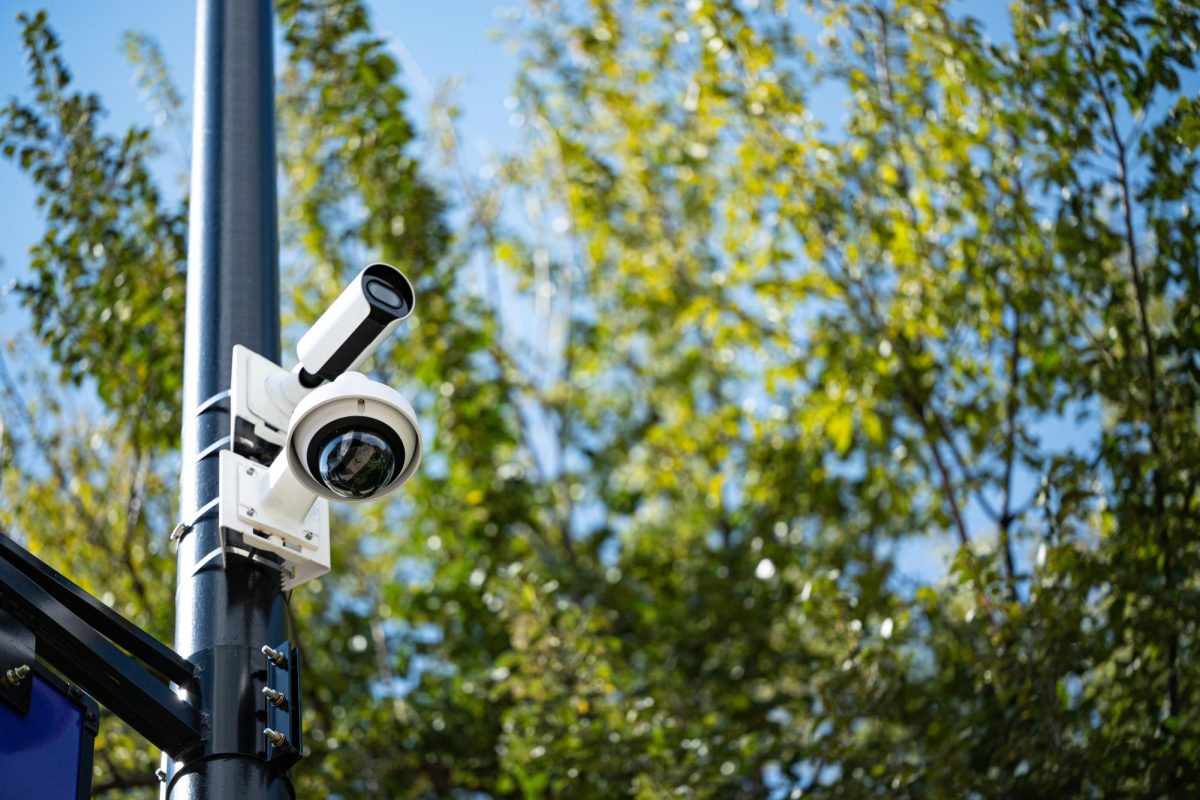


Perched high over roads and heavy-traffic areas across the nation, Flock cameras have been the subject of relentless backlash as concerns about privacy violations and law enforcement misuse have mounted.
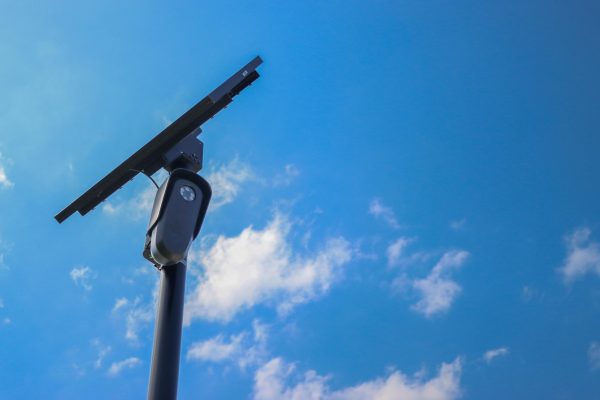
The black, commonly solar-powered cameras use artificial intelligence to read and recognize license plates and vehicles. There are 118,000 set up nationwide and 3,300 in the tri-state area, according to KSN.
In Manhattan, the Riley County Police Department operates 11 Flock cameras, with 10 on major roads on the outskirts of the city and one at the intersection of Moro Street and North 12th Street in Aggieville. Most were installed in 2023, but recently, local community members have expressed disapproval.
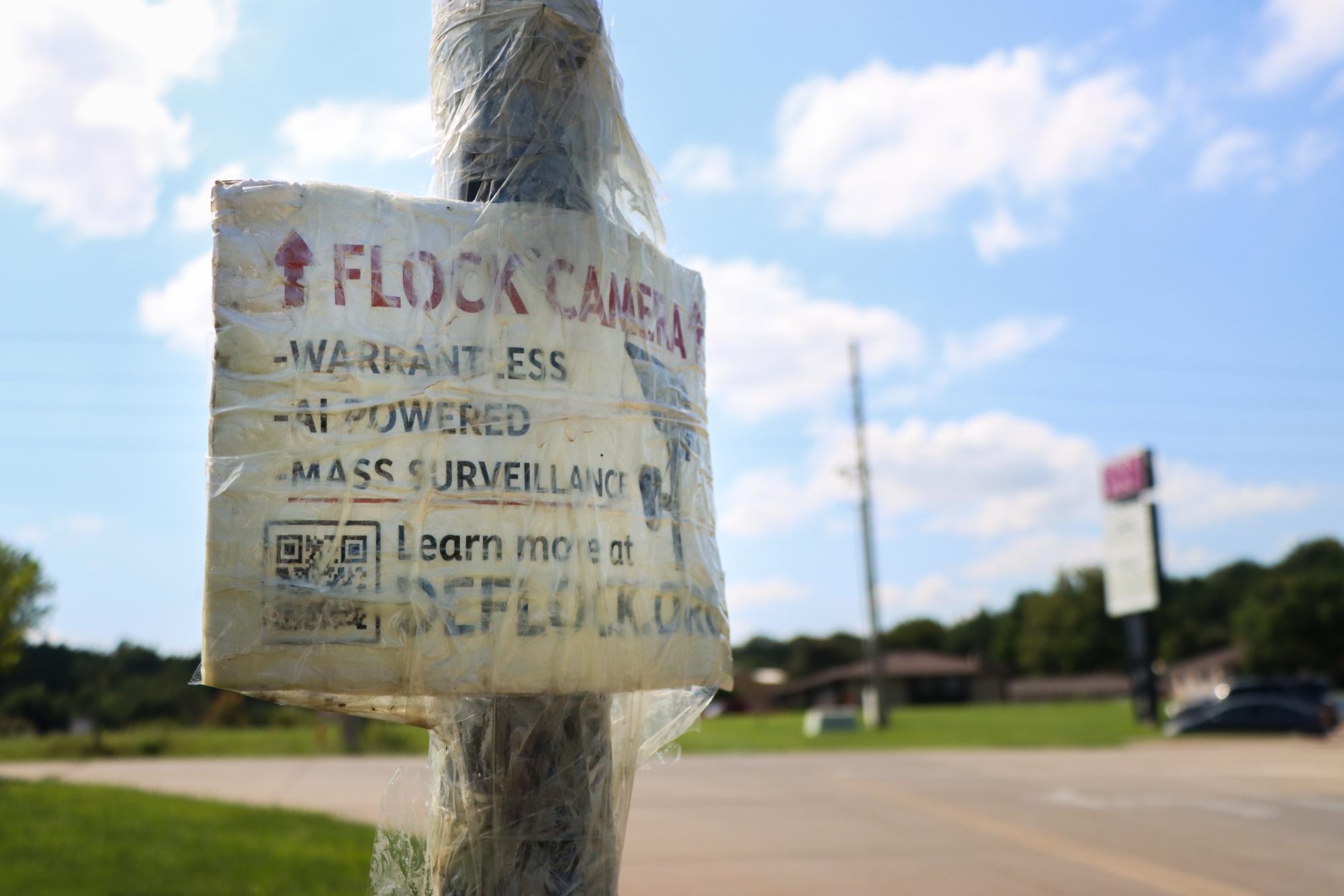
DeFlock Riley County is a community group that formed in July over concerns about government overreach through systems like Manhattan’s Flock cameras.
“They’re creating a surveillance state,” Al Terwelp, organizer of DeFlock Riley County, said. “A lot of people, including myself, don’t want this, and we feel like we have no choice but to take action and become advocates on this because there’s a lot at stake. Not only are the rights of our privacy for ourselves as individuals, but also for our families, friends, children, grandchildren.”
However, Maj. Brad Jager, who oversees RCPD’s investigations division, said Manhattan’s Flock cameras are connected to an internal criminal database and only alert the department if the cameras’ AI software captures a license plate in that database. He said the database includes vehicles registered to individuals with an active warrant, individuals connected to an active investigation or a missing person, but the cameras themselves don’t detect who the vehicle belongs to.
“It doesn’t read the registration [and] say that this is the individual’s car,” Jager said. “I think there’s a lot of misunderstanding there. It doesn’t pick up on individuals in the vehicle in regards to facial recognition or stuff like that.”
Instead, Jager said RCPD officers must manually compare a camera’s alert to their registration database to find out who owns the vehicle.
“We physically verify it because there are times where it’s not accurate,” Jager said. “Because one, it’s the wrong state, or maybe it read the character wrong. So we do verification. It’s a tip … It’s something that … tells us where to go, and then we have to verify before we have any intervention in it.”
On top of human verification, Jager said RCPD only allows Flock camera-trained officers and communications personnel to access them. Additionally, officers must go through the department’s intelligence agency to enter someone into an internal database, and there are strict parameters for database searches, which Jager said undergo multiple layers of audits throughout the year.
“Four of those audits are conducted by our investigations lieutenant,” Jager said. “So somebody outside of the realm of utilizing that system audits our searches … and makes sure that when somebody searched it or queried it, that it met the parameters. Then there’s two additional [audits]. … Our Internal Affairs Office will do one announced and one unannounced.”
RCPD can also use Flock’s own database to check if a vehicle of interest has recently passed under a Manhattan camera. The photos, however, only stay in Flock’s database for seven days before being wiped.
Terwelp said his main concern lies in the future of Flock cameras in Manhattan, claiming that a lack of funding is the only factor keeping RCPD from installing more cameras. He referenced the minutes from the Riley County Commission meeting on December 15, 2025, which indicate that RCPD intended to apply for a million-dollar grant to expand surveillance technology. However, Terwelp said he filed a records request and was told RCPD had no records related to the grant.
Jager said he would like to see the department install more Flock cameras in Manhattan, but denied that RCPD applied for a grant.
“I think you can see that, one, there’s evidence that it’s extremely beneficial for us, that it does solve crimes that would not have been solved,” Jager said. “Would I like to see us increase those? Yeah, I think it would be beneficial. But we have to do it responsibly, and we have to have the acceptance of the community to do so.”
Sgt. Michael Dunn, supervisor of RCPD’s intelligence unit, trains officers on Flock camera usage and frequently works with the department and Flock’s databases. He said Flock technology has successfully assisted over 250 cases since the cameras’ installation in 2023.
“We’ve used it for a wide range of successes,” Dunn said. “People with felony warrants for their arrest. We’ve used it to solve robberies. It’s assisted in a homicide case. There’s been a case where there was a missing juvenile out of Missouri. It led to officers being able to make contact with that car and recover the missing juvenile. We’ve used it to solve rape cases. We’ve used it to make arrests on violation of court orders and stalking cases and even sexual batteries.”
Terwelp, however, said DeFlock Riley County believes the majority of those crimes could have been solved without Flock cameras.
“We [DeFlock Riley County] are absolutely convinced that there is no need for this, especially in Riley County,” Terwelp said. “The large majority of all those crimes supposedly solved by the Flock cameras … those would have been solved through Riley County Police Department detective work. And so we can’t give the surveillance the credit for this.”
K-State students are also among those in Manhattan who are concerned about Flock cameras. Jamie Pemberton, senior in mathematics and social transformation studies, said the camera in Aggieville makes going out uncomfortable.
“I discovered that there was one in Aggieville, and now I’m hesitant about whether I want to go there and spend time with my friends there because I don’t want us to be surveilled by them [RCPD],” Pemberton said. “It’s already concerning that that’s something that has been implemented and that we can’t go enjoy ourselves without being surveilled by the state, but it’s another level when you know that there’s that AI-integrated technology.”
On the other hand, Silas Thoennes, senior in political science and president of Young Americans for Freedom at K-State, is aware of the privacy concerns but said the technology is nothing new and worth it for increased safety.
“I do think that most of the public outrage is logically inconsistent,” Thoennes said. “All the privacy concerns one might have with Flock cameras are already a thing with smartphones right now, and to a much greater extent. Also, it’s our [Young Americans for Freedom’s] position that the utility of combating crime on public roads does outweigh the privacy concerns.”
Jager said he acknowledges and welcomes the community pushback regarding Flock cameras, but stresses the technology’s importance.
“We understand people have, rightfully so, some concerns with it or [are] suspicious of it,” Jager said. “I totally understand that. But our community is a lot safer because of this technology.”